
Money Glossary
Short, plain-language definitions of the money terms you meet most often when budgeting, saving, borrowing and filing taxes in Canada, with links to the full guide for each one.
Get started free➜ Download the app➜
Money Glossary (Hub)
This money glossary defines 36 common personal finance terms in plain language, grouped into budgeting, saving and investing, borrowing and credit, Canadian accounts and tax, and the wider economy. Each entry gives a one or two sentence definition, and where we have a full guide or calculator, the term links straight to it.
How to use this money glossary
Personal finance has its own vocabulary, and a lot of it sounds more complicated than it is. This money glossary gives each term a short definition you can read in a few seconds. Terms are grouped by topic rather than alphabetically, so related ideas sit together.
Where a term has its own full guide, the heading links to it. For longer lessons on building a budget, saving and managing debt, visit our money learning centre.
| Topic | Example terms |
|---|---|
| Budgeting | Take-home pay, fixed expenses, sinking fund, cash flow |
| Saving and investing | Emergency fund, compound interest, net worth |
| Borrowing and credit | APR, credit score, debt-to-income ratio |
| Canadian accounts and tax | TFSA, RRSP, FHSA, RESP, GST/HST |
| Economy and currency | Inflation, purchasing power, exchange rate |
Budgeting terms
Budget
A plan for how you will use your money over a period, usually a month, matching expected income against spending and savings. Our guide on how to budget walks through the steps.
Take-home pay (net income)
The money that actually reaches your account after income tax, CPP, EI and other payroll deductions. Budgets should always be built on take-home pay, not gross salary.
Fixed expenses
Costs that stay the same each month, such as rent, a car payment or an insurance premium. See fixed vs variable expenses for examples.
Variable expenses
Costs that change with your usage or choices, such as groceries, fuel and dining out. They are usually the quickest place to find savings.
Cash flow
The difference between the money coming in and the money going out over a period. Positive cash flow creates a surplus; negative cash flow is covered by savings or debt. Read what personal cash flow means.
Sinking fund
Money set aside a little at a time for a known future expense, such as car registration or holiday gifts, so it does not land all at once. More in our sinking funds guide.
50/30/20 rule
A guideline that splits take-home pay into 50% needs, 30% wants and 20% savings and extra debt repayment. See the 50/30/20 rule explained.
Zero-based budget
A budget in which every dollar of income is assigned a job, so income minus planned spending and saving equals zero.
Envelope budgeting
A method that caps spending by putting a fixed amount of cash, or a digital equivalent, into an envelope for each category and stopping when it is empty.
Pay yourself first
Moving money into savings as soon as you are paid, before any discretionary spending, so saving happens automatically.
Lifestyle creep
The tendency for spending to rise as income rises, so a raise leaves you no better off in savings.
Saving and investing terms
Emergency fund
Cash kept aside for unexpected costs or a loss of income, often three to six months of essential expenses. Our emergency fund guide explains how to build one.
Compound interest
Interest earned on both the original amount and on interest already added, so growth speeds up over time. Read what compound interest is.
Rule of 72
A shortcut for estimating how long money takes to double: divide 72 by the annual rate of return. At 6%, about 12 years.
Savings rate
The share of your take-home pay that you save, usually shown as a percentage. The savings rate calculator works it out.
Net worth
Everything you own minus everything you owe at a point in time. Learn how to calculate net worth.
Asset
Something you own that has value, such as cash, investments, a home or a car.
Liability
Money you owe, such as a mortgage, car loan, student loan or credit card balance.
GIC
A guaranteed investment certificate: a deposit with a bank or credit union that pays a set rate of interest for a fixed term, with your principal protected.
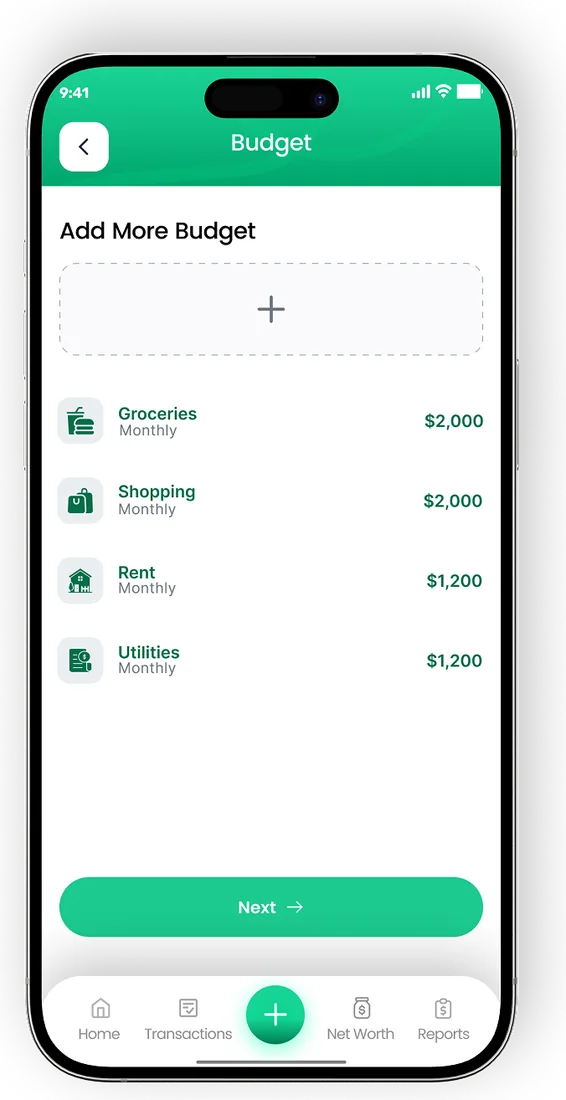
Budgets that update themselves
- Set monthly limits for every category
- See what is left to spend in real time
- Get a nudge before a category runs out


Borrowing and credit terms
APR
Annual percentage rate: the yearly cost of borrowing expressed as a percentage, including certain required fees for loans. See what APR means.
Principal
The amount you originally borrowed, or the part of a loan balance that is not interest. Extra payments usually go straight to principal.
Credit score
A three-digit number that summarizes how reliably you have handled credit. In Canada, scores run from 300 to 900. Read what a credit score is.
Credit report
A record of your credit accounts, balances and payment history, kept by credit bureaus and used to calculate your credit score.
Debt-to-income ratio
Your monthly debt payments divided by your monthly gross income, which lenders use to judge how much more you can borrow. See debt-to-income ratio explained.
Minimum payment
The smallest amount you must pay on a credit card or line of credit by the due date to keep the account in good standing. Paying only the minimum keeps interest charges high.
Debt avalanche and debt snowball
Two payoff strategies: the avalanche pays the highest interest rate first to save the most money, while the snowball pays the smallest balance first for quick wins. Compare them in debt snowball vs avalanche.
Canadian accounts and tax terms
TFSA
A Tax-Free Savings Account, in which investment growth and withdrawals are not taxed. Read what a TFSA is.
RRSP
A Registered Retirement Savings Plan: contributions are tax-deductible and growth is tax-sheltered, with tax paid on withdrawal. Read what an RRSP is.
FHSA
A First Home Savings Account for first-time buyers, combining a tax deduction on contributions with tax-free withdrawals for a qualifying home. Read what an FHSA is.
RESP
A Registered Education Savings Plan for a child's post-secondary education, eligible for the Canada Education Savings Grant. Read what an RESP is.
GST and HST
The federal Goods and Services Tax and the Harmonized Sales Tax, which combines GST with provincial sales tax in participating provinces. See GST vs HST.
Marginal tax rate
The rate of tax you pay on your next dollar of income. It is higher than your average tax rate because income is taxed in brackets.
Capital gain
The profit when you sell an investment or property for more than you paid. Only part of a capital gain is taxable in Canada, and gains inside a TFSA are not taxed at all.
Economy and currency terms
Budgeting across currencies raises its own questions. EMOH Pay supports 148 currencies with automatic conversion, so you can see spending in your home currency even when you pay in another. It is free to start on iPhone, Android and the web.
Inflation
The general rise in prices over time, which reduces what each dollar can buy. In Canada it is measured by the Consumer Price Index. Read what inflation is.
Purchasing power
How much a unit of money can buy. Inflation reduces purchasing power; deflation increases it.
Exchange rate
The price of one currency in terms of another. Rates change constantly, and the rate a transfer service offers usually includes a margin over the mid-market rate.
Plan your month in EMOH Pay
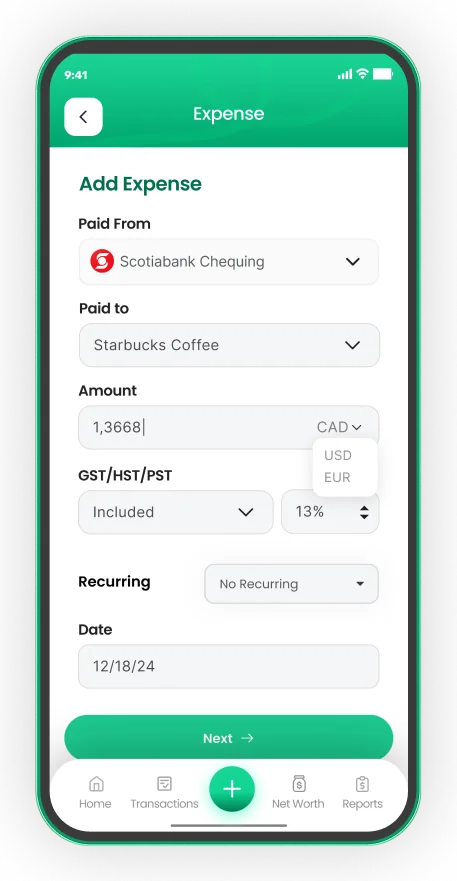

Put the numbers on autopilot
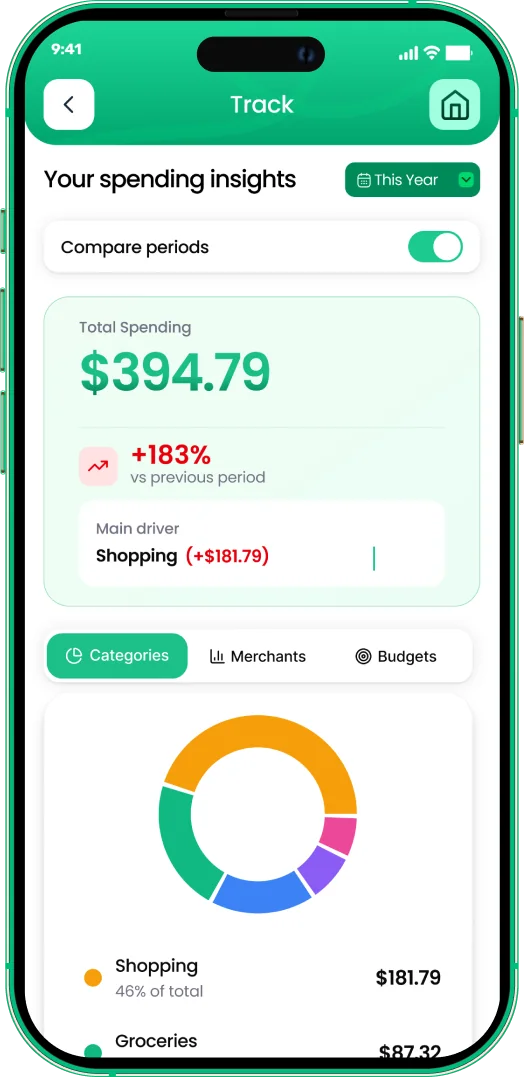
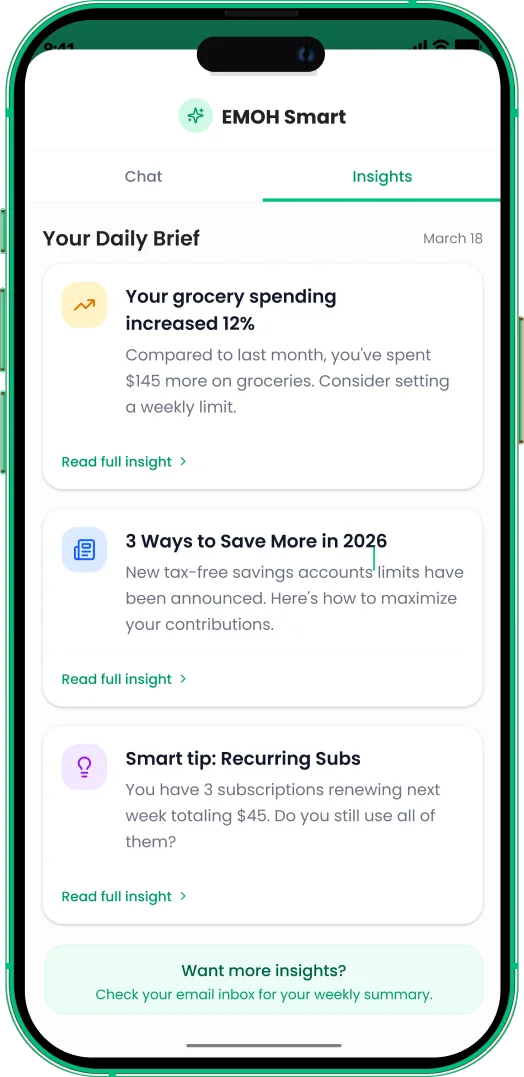
EMOH Pay tracks your spending, budgets and net worth on your phone and in the browser, always in sync. Free to start, made in Canada.
Get started free➜Money Glossary: frequently asked questions
What is the difference between gross and net income?
Gross income is your pay before any deductions. Net income, or take-home pay, is what is left after income tax, CPP, EI and other payroll deductions. Budgets should use net income.
What is the difference between an asset and a liability?
An asset is something you own that has value, such as savings or a home. A liability is money you owe, such as a loan or credit card balance. Assets minus liabilities equals your net worth.
What is the difference between APR and interest rate?
The interest rate is the base cost of borrowing. APR adds certain required fees to show the full yearly cost. For most credit cards they are effectively the same number.
Which money terms should beginners learn first?
Start with take-home pay, fixed and variable expenses, cash flow, emergency fund and APR. Those five cover most everyday budgeting decisions. Then move on to TFSA, RRSP and compound interest when you start saving and investing.
Is there an app that explains money terms as I budget?
EMOH Pay includes Ask AI, which can answer questions about your budget and explain terms in plain language. EMOH Pro, at $4.99 a month, adds more advanced AI.
Sources and further reading
Related guides and tools
What is compound interest? A plain definition, the formula, how compounding frequency changes results, simple vs compound…
What Is APR?What is APR? A plain definition of annual percentage rate, how it differs from an interest rate and APY, how credit card APR…
What Is Inflation?What is inflation? A plain definition, how Canada measures it with the CPI, what causes it, the Bank of Canada's 2% target…
Fixed vs Variable ExpensesFixed vs variable expenses explained: what each means, examples, where periodic bills fit and how to budget for each so…
What Is Cash Flow (Personal)?What is cash flow in personal finance? A plain definition, how to calculate your monthly cash flow, a worked Canadian…
What Is a TFSA?What is a TFSA? A plain-language definition of Canada's Tax-Free Savings Account: how it works, what you can hold…
Glossary entries
Detailed definitions for the most searched money terms.
Money terms explained
- Fixed vs Variable Expenses: Meaning and Examples
- Money Glossary: Personal Finance Terms Defined
- What Is APR? Annual Percentage Rate Explained
- What Is Cash Flow (Personal)? Meaning and Examples
- What Is Compound Interest? Definition and Examples
- What Is Debt-to-Income Ratio? Definition and Example
- What Is Inflation? Definition, Causes and Examples
- What Is a Credit Score? Definition and Examples
Canadian accounts explained
Start free today
Free on iPhone, Android and the web. Upgrade to EMOH Pro anytime for bank sync and advanced AI.
Download for iOS➜ Get it on Android➜