
The 50/30/20 Rule Explained
Half of your take-home pay for needs, 30% for wants, 20% for savings and debt. Here is what goes where, a worked example, and how to adapt it when rent alone eats half your income.
Get started free➜ Download the app➜
What is the 50/30/20 rule?
The 50/30/20 rule is a budgeting guideline that divides after-tax income into three buckets: 50% for needs such as rent, groceries and minimum debt payments, 30% for wants such as dining out and streaming, and 20% for savings and extra debt repayment. Popularised by Senator Elizabeth Warren in 2005, it is simple enough to keep and flexible enough to adjust.
What counts as a need, a want and savings
The rule only works if you sort spending honestly. A need is something you cannot stop paying without real consequences. A want is anything you could cut this month and be fine. Savings includes debt paid beyond the minimum, because both build net worth.
| Bucket | What belongs there | Common mistake |
|---|---|---|
| Needs (50%) | Rent or mortgage, utilities, groceries, transit or car costs, insurance, phone, minimum debt payments, child care | Counting the full grocery bill as a need when a third of it is snacks and takeaway |
| Wants (30%) | Restaurants, streaming, hobbies, travel, clothes beyond basics, gym, gifts | Treating a car upgrade or a bigger apartment as a need |
| Savings (20%) | Emergency fund, TFSA and RRSP contributions, extra debt principal, down-payment fund | Skipping the bucket entirely when money is tight instead of scaling it down |
A worked example on $4,000 of monthly take-home pay
Take a monthly net income of $4,000. The split gives $2,000 for needs, $1,200 for wants and $800 for savings and debt. A sample month that fits looks like this:
| Category | Amount | Bucket |
|---|---|---|
| Rent | $1,350 | Needs |
| Groceries | $380 | Needs |
| Transit, phone, insurance | $270 | Needs |
| Eating out and coffee | $300 | Wants |
| Streaming, gym, hobbies | $180 | Wants |
| Clothes, gifts, fun money | $720 | Wants |
| Emergency fund | $300 | Savings |
| TFSA | $300 | Savings |
| Extra credit card payment | $200 | Savings |
Notice that wants is the largest discretionary bucket. That is deliberate: a budget you enjoy is a budget you keep. If your needs already exceed 50%, the fix is not to feel guilty; it is to shrink wants first and protect at least a small savings line.
When the 50/30/20 rule does not fit
- High-rent cities. In Toronto or Vancouver a one-bedroom alone can be 40% of take-home pay. Try 60/20/20 or 70/20/10 and revisit when income rises.
- High-interest debt. If you carry credit-card balances at 20% APR, push wants down to 20% and send the freed 10% to the debt. The avalanche method pays the highest rate first.
- Irregular income. Freelancers should budget from a conservative baseline month, then allocate any surplus 50/30/20 when it arrives.
- Aggressive savers. Anyone chasing early retirement can flip the last two buckets to 50/20/30 or beyond. The rule is a floor for savings, not a ceiling.
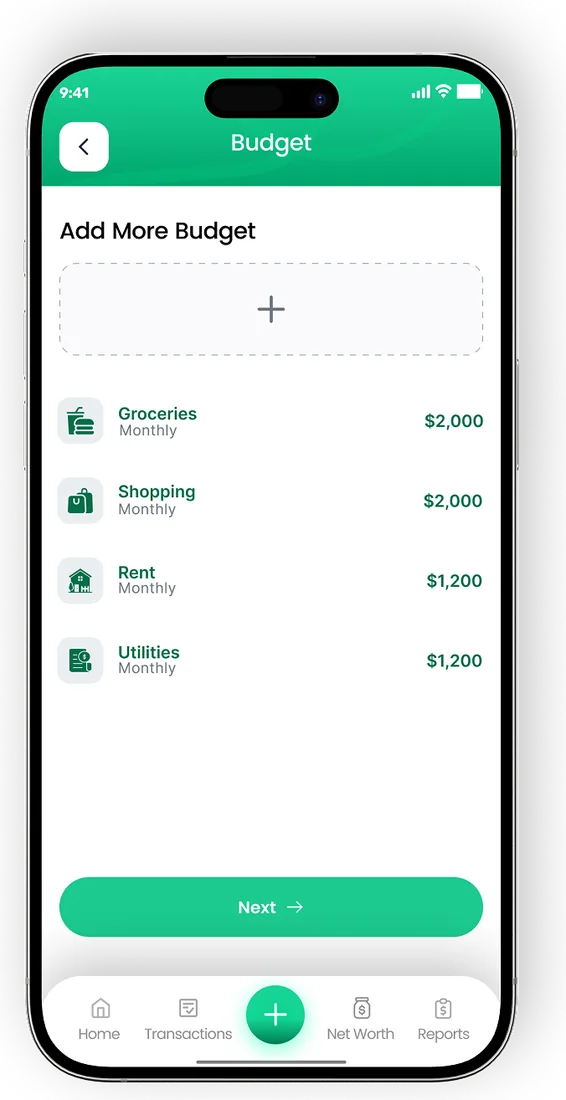
Budgets that update themselves
- Set monthly limits for every category
- See what is left to spend in real time
- Get a nudge before a category runs out


What does 50/30/20 look like at different incomes?
The percentages stay the same as income changes, but the dollar amounts shift a lot. At lower incomes the needs bucket is usually the hardest to keep at 50%, because rent and groceries do not shrink with pay. At higher incomes it becomes easier to push savings past 20%.
| Monthly take-home pay | Needs (50%) | Wants (30%) | Savings and debt (20%) |
|---|---|---|---|
| $2,500 | $1,250 | $750 | $500 |
| $3,500 | $1,750 | $1,050 | $700 |
| $5,000 | $2,500 | $1,500 | $1,000 |
| $7,000 | $3,500 | $2,100 | $1,400 |
If your needs bucket is already above 50% at your income, treat the rule as a direction rather than a test. Lower wants first, protect even 5% for savings, and revisit the split whenever your pay or rent changes. The budget calculator does the arithmetic for any income.
How to start using it this month
- Find your true take-home pay: the amount deposited after tax, CPP and EI. Use our income tax calculator if you only know your gross salary.
- Multiply by 0.5, 0.3 and 0.2 to get your three targets, or let the 50/30/20 budget calculator do it.
- Pull last month's transactions and tag each one as need, want or savings. Most people discover their wants bucket is closer to 45%.
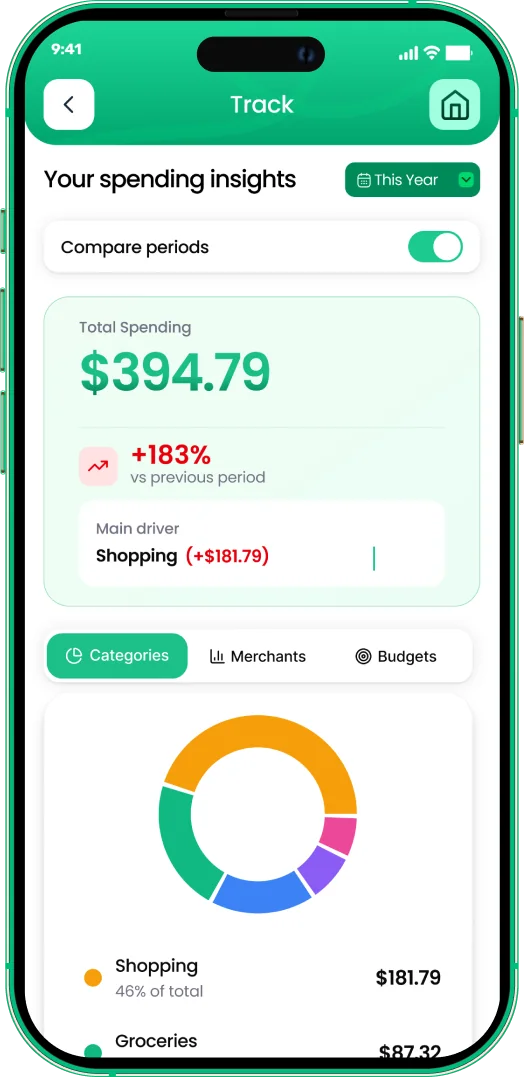
- Set the three buckets as budgets in EMOH Pay. The app sorts new transactions into categories automatically and shows what is left in each bucket in real time.
- Review on the first of the month. Move money between wants and savings, never out of needs.
50/30/20 versus other budgeting methods
The 50/30/20 rule trades precision for simplicity. Zero-based budgeting assigns every dollar a job and suits people who like control. The envelope method caps cash spending by category and suits impulse spenders. Pay-yourself-first moves savings out the moment pay lands and suits people who dislike tracking. Many EMOH Pay users start with 50/30/20 and move to zero-based budgeting once the habit sticks.
Plan your month in EMOH Pay
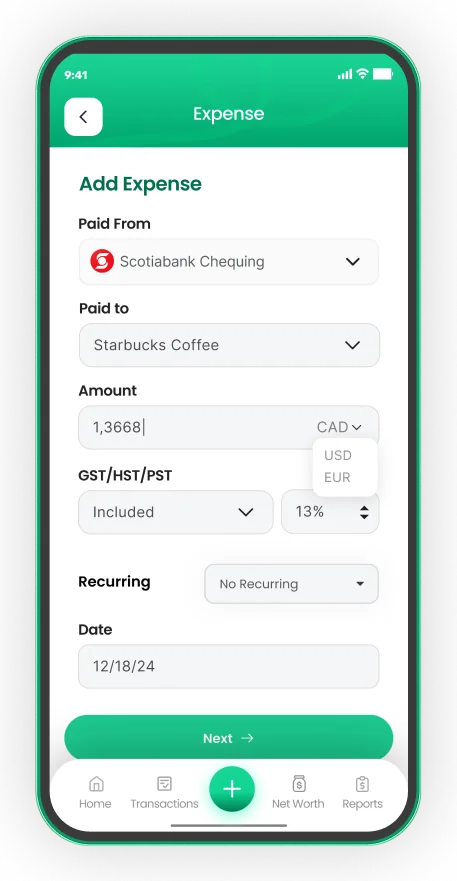

Put the numbers on autopilot
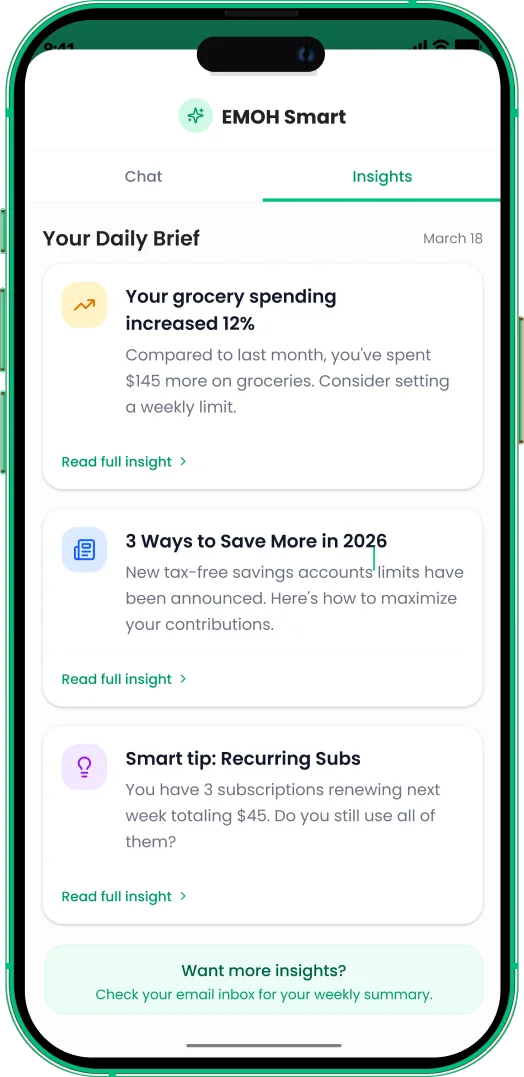
EMOH Pay tracks your spending, budgets and net worth on your phone and in the browser, always in sync. Free to start, made in Canada.
Get started free➜The 50/30/20 Rule Explained: frequently asked questions
Is the 50/30/20 rule based on gross or net income?
Net income: what lands in your account after income tax, CPP and EI. Budgeting from gross pay overstates every bucket by 20% to 30%.
Do minimum debt payments count as needs or savings?
Minimum payments are needs because missing them has consequences. Anything above the minimum counts toward the 20% savings bucket.
Should retirement contributions from my employer count?
Only money out of your own pay counts toward your 20%. An employer match is a bonus on top, though it is worth taking in full.
Can a couple use the 50/30/20 rule together?
Yes. Combine both take-home incomes, apply the split to the household total, and keep separate wants allowances inside the 30% so each partner has guilt-free money. EMOH Pay's family sharing shows both partners the same live buckets.
Who created the 50/30/20 rule?
Senator Elizabeth Warren and Amelia Warren Tyagi described it in their 2005 book All Your Worth. It has since become the most widely taught beginner budget.
Sources and further reading
Related guides and tools
The 50/30/20 rule splits after-tax income: 50% to needs, 30% to wants, 20% to savings. Enter your monthly take-home pay to…
Zero-Based Budgeting: The Complete Beginner Guide 2026What if every dollar you earned had a specific destination — before you spent a single penny of it? That’s the premise…
Envelope Budgeting MethodEnvelope budgeting gives every spending category a fixed pot of money. See how the cash envelope system works, a worked…
How to Budget: The Complete GuideBudgeting is deciding where money goes before it leaves. This guide covers the 4 steps: know your income, list fixed costs…
Budgeting Methods Compared50/30/20, zero-based, envelopes or pay-yourself-first — the best budgeting method is the one you'll still be using in March.…
Income Tax Calculator Canada 2026Estimate your 2026 Canadian income tax, CPP, EI and take-home pay in every province and territory, with federal and…
Start free today
Free on iPhone, Android and the web. Upgrade to EMOH Pro anytime for bank sync and advanced AI.
Download for iOS➜ Get it on Android➜