
What Is an FHSA?
The FHSA combines a tax deduction on the way in and tax-free withdrawals on the way out when you buy your first home. Here is what it is, who qualifies and how it fits with a TFSA or RRSP.
Get started free➜ Download the app➜
What Is an FHSA?
An FHSA, or First Home Savings Account, is a Canadian registered account that helps first-time buyers save for a home. Contributions are tax-deductible like an RRSP, and qualifying withdrawals to buy a first home are tax-free like a TFSA. You can contribute $8,000 a year, up to $40,000 over your lifetime.
What is an FHSA? The definition in plain language
An FHSA is a First Home Savings Account, a registered account the federal government introduced in April 2023 for people who have not owned a home recently. It is the only Canadian account that gives you both a tax deduction when you contribute and a tax-free withdrawal when you use the money for its purpose.
Like the TFSA and RRSP, the FHSA is a wrapper rather than an investment. You open one at a bank, credit union or brokerage and hold cash, GICs, bonds, mutual funds, ETFs or stocks inside it.
If you never buy a home, the money is not trapped. You can move it into an RRSP or RRIF without tax and without using any RRSP room, which makes the FHSA low-risk to open even if your plans are uncertain.
Who can open an FHSA?
You can open an FHSA if you are a Canadian resident, at least 18 years old and no older than 71, and a first-time home buyer. For FHSA purposes, first-time means you did not live in a home that you or your spouse or common-law partner owned at any point in the current calendar year or the previous four.
- Age. At least 18 (or the age of majority where some institutions require it) and not past the end of the year you turn 71.
- Residency. You must be a resident of Canada to open the account.
- First-time buyer. You meet the four-year rule, even if you owned a home long ago.
- Couples. Each qualifying partner can open their own FHSA, so a couple can save up to $80,000 in total.
How does an FHSA work?
An FHSA gives you $8,000 of contribution room a year, up to $40,000 in total. Room only starts building once you open the account, so opening one early, even with a small deposit, starts the clock. Unused room carries forward, but only up to $8,000, so the most you can add in one year is $16,000.
| Rule | How it works |
|---|---|
| Annual limit | $8,000, starting the year you open the account |
| Lifetime limit | $40,000 of contributions |
| Carry-forward | Up to $8,000 of unused room into the next year |
| Tax deduction | Yes; you can claim it now or carry it forward |
| Qualifying withdrawal | Tax-free when used to buy a first home |
| Time limit | Close within 15 years or by the end of the year you turn 71 |
| If you do not buy | Transfer to an RRSP or RRIF tax-free, or withdraw as taxable income |
| Over-contributing | Tax of 1% per month on the excess |
Unlike an RRSP, there is no 60-day rule. Contributions count for the calendar year in which you make them. To see how much an FHSA could grow and the tax you could save, try the FHSA calculator.
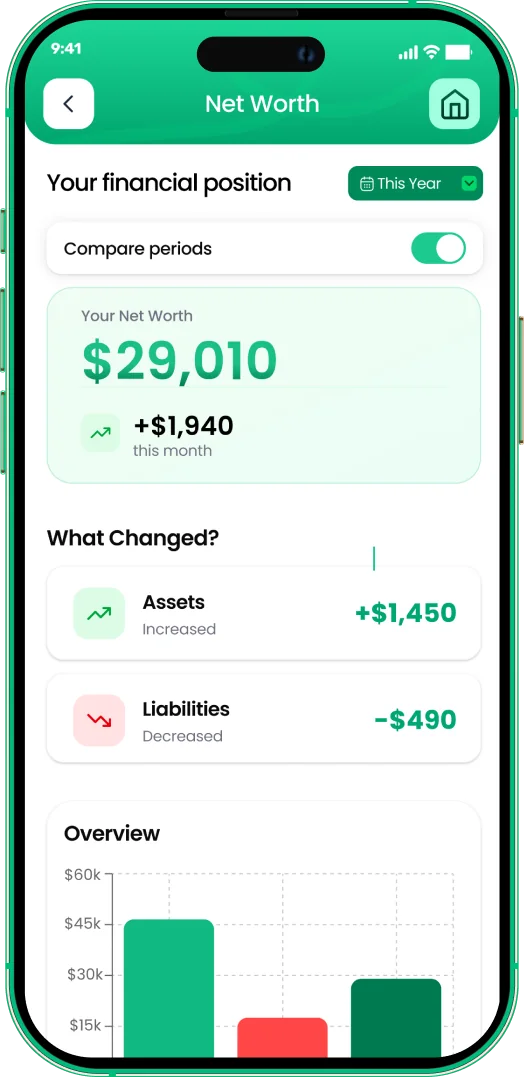
Watch your net worth grow
- Add assets and debts in any of 148 currencies
- See what changed month by month
- Set savings goals and track progress


An FHSA example: saving for a first home
Suppose you open an FHSA and contribute $8,000 a year for five years. At a 30% marginal tax rate, each contribution cuts your tax by about $2,400, or about $12,000 over the five years. If the money earns 5% a year, the account reaches about $46,400. You withdraw it all tax-free for your down payment.
Put the tax refunds into a TFSA and the savings grow further. This is why the FHSA is often the first account a would-be buyer fills. Our guide on how to save for a house in Canada covers the rest of the down payment plan, and the mortgage affordability calculator shows what price range your savings and income support.
FHSA vs TFSA vs RRSP Home Buyers' Plan
| Feature | FHSA | TFSA | RRSP Home Buyers' Plan |
|---|---|---|---|
| Deduction on deposits | Yes | No | Yes |
| Tax on a home withdrawal | None, if qualifying | None | None, if repaid |
| Repayment needed | No | No | Yes, over up to 15 years |
| Maximum for a home | $40,000 plus growth | Your available room | $60,000 |
| Use for other goals | Transfer to RRSP | Any purpose | Retirement |
You can use the FHSA and the Home Buyers' Plan for the same home, which lets a single buyer draw on both. Many buyers fill the FHSA first, then use a TFSA for extra savings and closing costs.
How to open an FHSA and start saving
- Confirm you meet the first-time buyer rule and are at least 18.
- Open an FHSA at a bank, credit union or brokerage, even with a small deposit, so your $8,000 of annual room starts.
- Choose investments that match your timeline. Buying within two years usually calls for cash or GICs; a longer horizon may suit a mix of funds.
- Automate a monthly contribution. About $667 a month fills the $8,000 yearly limit. EMOH Pay lets you set a down payment savings goal and track progress alongside your budget.
- Claim the deduction on your tax return, and keep your receipts. For more account basics, visit our money guides.
Your net worth in EMOH Pay
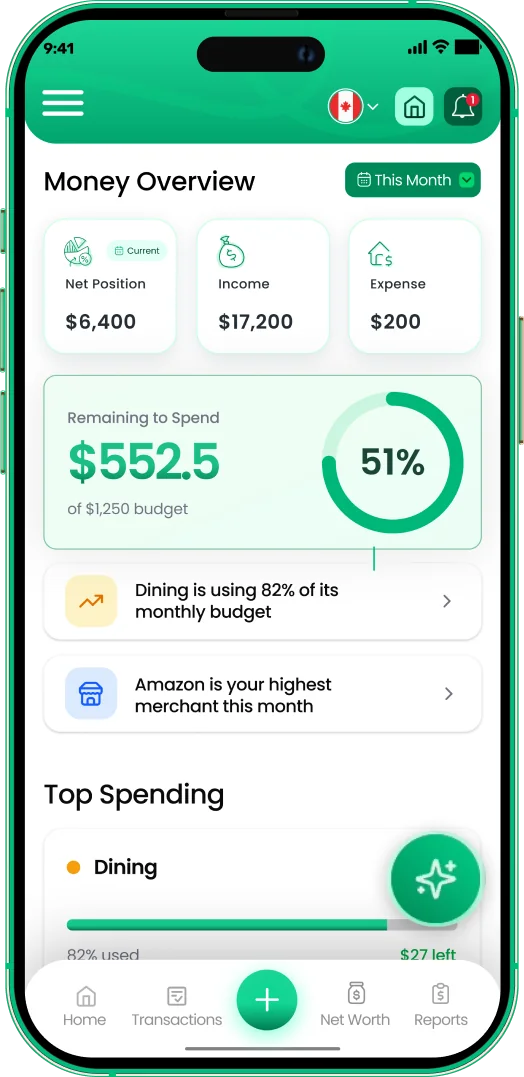

Put the numbers on autopilot
EMOH Pay tracks your spending, budgets and net worth on your phone and in the browser, always in sync. Free to start, made in Canada.
Get started free➜What Is an FHSA?: frequently asked questions
What does FHSA stand for?
FHSA stands for First Home Savings Account. It is a registered account introduced in 2023 to help first-time buyers in Canada save for a down payment with tax advantages.
Is an FHSA better than a TFSA for a house?
For most first-time buyers, yes. Both give tax-free withdrawals for a home, but only the FHSA gives a tax deduction on contributions. Once the FHSA is full, a TFSA is a good place for additional savings.
What happens to my FHSA if I don't buy a house?
You can transfer the balance to an RRSP or RRIF without tax and without using RRSP room. If you withdraw it as cash instead, the full amount is taxed as income. The account must be closed within 15 years of opening it or by the end of the year you turn 71.
Can I use the FHSA and the Home Buyers' Plan together?
Yes. Since the FHSA launched, you can make a qualifying FHSA withdrawal and a Home Buyers' Plan withdrawal for the same home, as long as you meet the rules of each.
Can my partner and I both open an FHSA?
Yes, if each of you qualifies as a first-time buyer. Each person has their own $8,000 yearly and $40,000 lifetime limit. EMOH Pay's family sharing lets both partners follow a shared down payment goal with separate logins.
Sources and further reading
Related guides and tools
FHSA calculator: see how your First Home Savings Account grows year by year, when you hit the $40,000 lifetime limit and how…
How to Save for a House in CanadaHow to save for a house in Canada: work out your down payment, use the FHSA, RRSP and TFSA, budget for closing costs and…
What Is a TFSA?What is a TFSA? A plain-language definition of Canada's Tax-Free Savings Account: how it works, what you can hold…
What Is an RRSP?What is an RRSP? A plain-language guide to Canada's Registered Retirement Savings Plan: how the deduction works…
Mortgage Affordability Calculator CanadaMortgage affordability calculator for Canada: see the home price you could qualify for under the stress test, then check…
Money Guides: Budgeting, Saving and DebtPractical, Canadian-first money guides — budgeting, saving, debt, taxes and family finances, all in plain language. Free to…
Start free today
Free on iPhone, Android and the web. Upgrade to EMOH Pro anytime for bank sync and advanced AI.
Download for iOS➜ Get it on Android➜