
What Is Compound Interest?
Compound interest is interest earned on interest. Over long periods it turns modest savings into large sums, and it works just as powerfully against you on debt.
Get started free➜ Download the app➜
What Is Compound Interest?
Compound interest is interest calculated on both the original amount and the interest already added to it, so your balance grows faster each period. For example, $10,000 earning 5% a year compounded annually becomes about $16,289 after 10 years, compared with $15,000 under simple interest. The longer money compounds, the bigger the gap becomes.
What is compound interest? The definition in plain language
Compound interest means the interest you earn is added to your balance, and from then on it earns interest too. Each period starts from a slightly larger base, so growth speeds up over time. That is why people describe it as interest on interest.
Simple interest, by contrast, is always calculated on the original amount only. On $10,000 at 5%, simple interest pays $500 every year forever. Compound interest pays $500 in year one, $525 in year two, about $551 in year three and keeps rising.
This page explains the idea. To run your own numbers with regular contributions, use the compound interest calculator.
How does compound interest work over time?
Compound interest works slowly at first and then quickly. In the early years most of the growth comes from your own deposits. Later, the interest itself becomes the main engine. The chart shows $10,000 left alone at 5% a year, compounded annually, with no further deposits.
The balance grows by about $6,300 in the first 10 years but by nearly $16,700 in the last 10. Nothing changed except time. A handy shortcut is the rule of 72: divide 72 by the annual rate to estimate how many years it takes to double. At 6%, that is about 12 years. The rule of 72 calculator does it for any rate.
Simple vs compound interest: a side-by-side example
Here is the same $10,000 at 5% a year under both methods. The difference is small after a few years and dramatic after a few decades.
| After | Simple interest | Compound interest (annual) | Extra from compounding |
|---|---|---|---|
| 10 years | $15,000 | $16,289 | $1,289 |
| 20 years | $20,000 | $26,533 | $6,533 |
| 30 years | $25,000 | $43,219 | $18,219 |
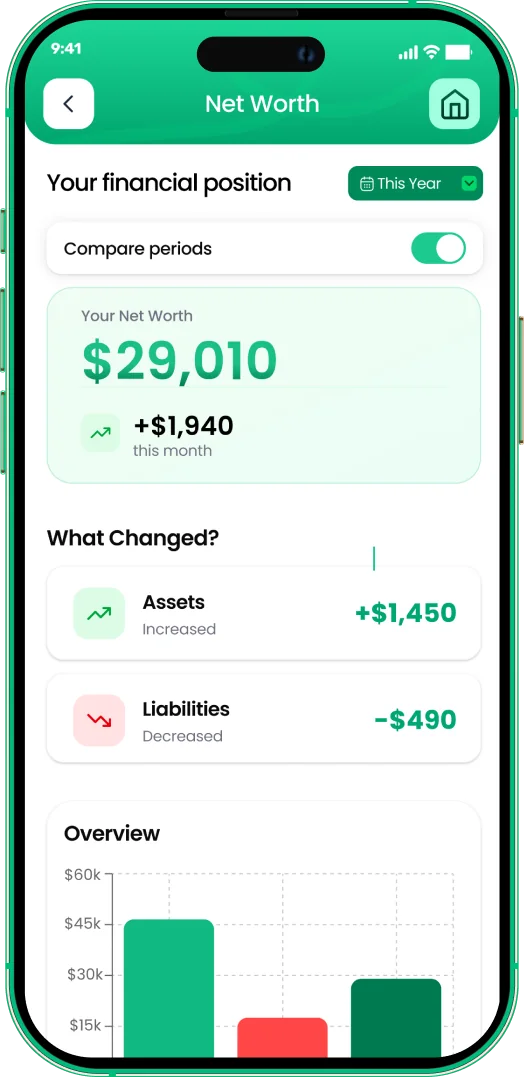
Watch your net worth grow
- Add assets and debts in any of 148 currencies
- See what changed month by month
- Set savings goals and track progress


The compound interest formula and compounding frequency
The standard formula is A = P(1 + r/n)^(nt), where A is the final amount, P is the starting principal, r is the annual rate as a decimal, n is the number of times interest compounds each year and t is the number of years.
The more often interest compounds, the more you end up with, though the gains shrink as frequency rises. The table uses $10,000 at 5% for 10 years.
| Compounding | n per year | Balance after 10 years |
|---|---|---|
| Annually | 1 | $16,289 |
| Quarterly | 4 | $16,436 |
| Monthly | 12 | $16,470 |
| Daily | 365 | $16,487 |
This is also why savings accounts advertise an annual percentage yield, which includes compounding, while lenders quote an APR, which does not. Our guide to APR explains the difference.
Why starting early matters so much
Because growth accelerates with time, the years at the start count the most. $5,000 invested at 6% a year grows to about $28,717 after 30 years, but to about $51,429 after 40 years. Ten extra years nearly doubles the result without a single extra dollar deposited.
In Canada, a TFSA lets investment growth compound without tax, which keeps more of each year's gains working for you. Interest earned in a regular non-registered account is taxable every year, which slows compounding.
- Start small but start now. A modest amount invested early can beat a larger amount invested later.
- Reinvest earnings. Taking interest or dividends out as cash stops them compounding.
- Keep costs low. Fees compound too, reducing your return every year.
- Remember inflation. Real growth is your return minus inflation.
Compound interest on debt
Compounding works against you when you borrow. Unpaid credit card interest is added to the balance and then charged interest itself, which is why a balance at around 20% can grow quickly even if you stop using the card. Paying more than the minimum, and paying the highest-rate debt first, breaks the cycle.
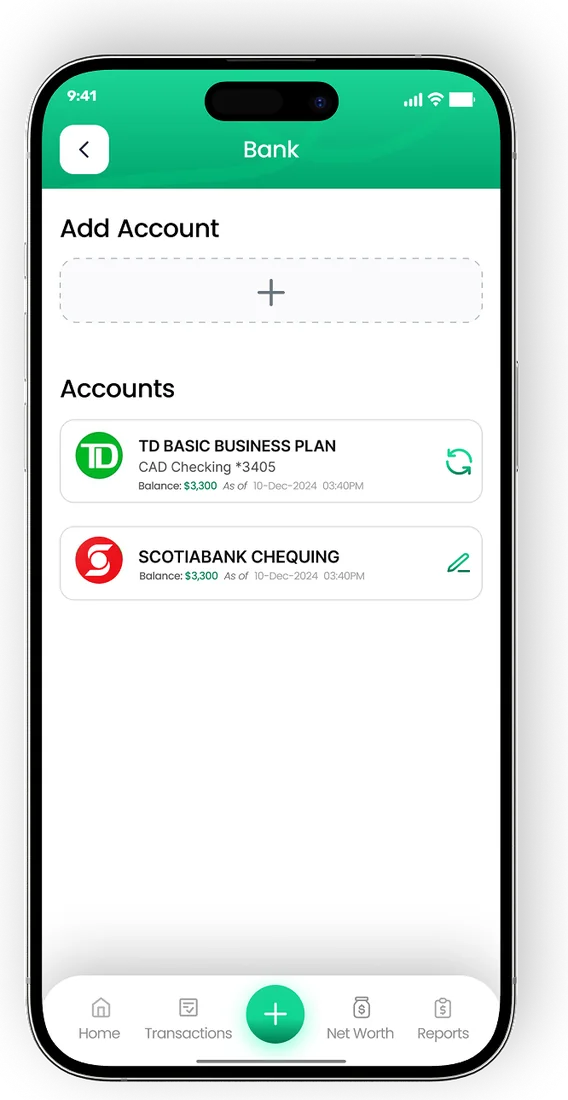
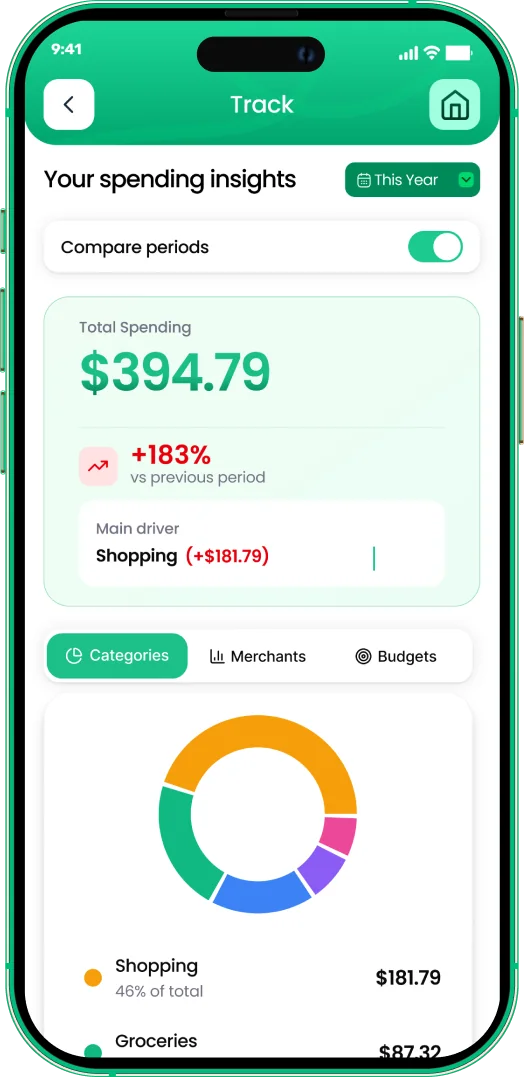
Tracking both sides helps. EMOH Pay's savings goals show your progress toward each target, and its net worth view shows savings and debts together so you can see compounding working in your favour over time.
Your net worth in EMOH Pay
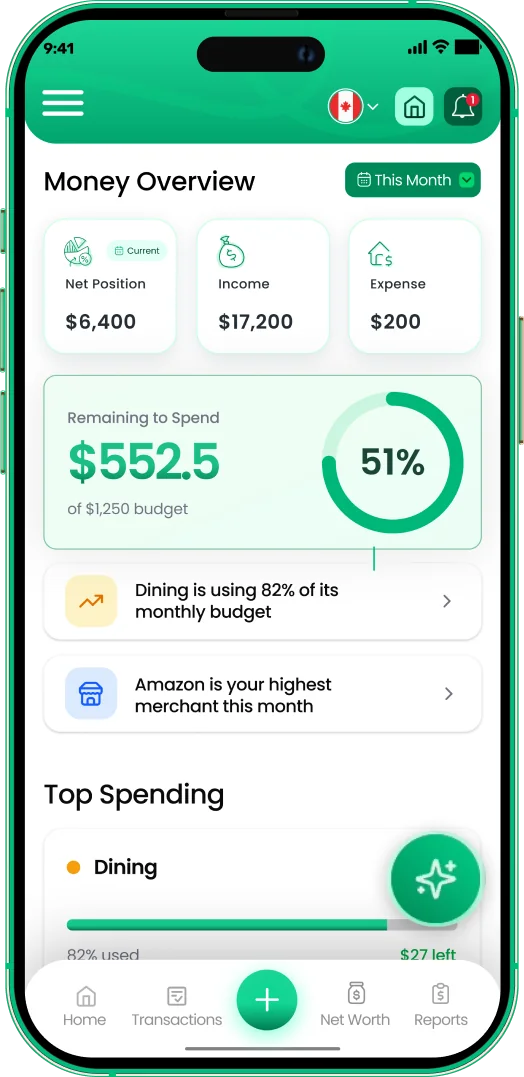

Put the numbers on autopilot
EMOH Pay tracks your spending, budgets and net worth on your phone and in the browser, always in sync. Free to start, made in Canada.
Get started free➜What Is Compound Interest?: frequently asked questions
What is the difference between simple and compound interest?
Simple interest is calculated only on the original amount. Compound interest is calculated on the original amount plus any interest already added. Over long periods, compound interest produces much larger balances.
How often is interest compounded?
It depends on the product. Savings accounts in Canada often calculate interest daily and pay it monthly, many GICs compound annually, and credit card interest is usually charged monthly. Check the terms of each account.
Is compound interest good or bad?
It is good when you save or invest because your money grows faster. It is bad when you owe money because unpaid interest grows your debt. The same maths applies in both directions.
How long does it take money to double with compound interest?
Use the rule of 72: divide 72 by the annual interest rate. At 4%, money doubles in about 18 years; at 8%, in about 9 years. It is an estimate that works best for rates between about 2% and 12%.
Do stocks earn compound interest?
Not interest exactly, but reinvested dividends and rising prices compound in the same way. Returns vary from year to year, so the growth is not as smooth as a fixed interest rate.
Sources and further reading
Related guides and tools
Free compound interest calculator. Enter a starting amount, monthly contribution, return and years to see how your savings…
Rule of 72 CalculatorUse the rule of 72 to see how long your money takes to double at any interest rate or return, compared with the exact answer…
What Is APR?What is APR? A plain definition of annual percentage rate, how it differs from an interest rate and APY, how credit card APR…
What Is a TFSA?What is a TFSA? A plain-language definition of Canada's Tax-Free Savings Account: how it works, what you can hold…
What Is Inflation?What is inflation? A plain definition, how Canada measures it with the CPI, what causes it, the Bank of Canada's 2% target…
Savings Goal Calculator — Free CalculatorHow much to save per month? Enter your target amount and months until deadline — get your required monthly contribution…
Start free today
Free on iPhone, Android and the web. Upgrade to EMOH Pro anytime for bank sync and advanced AI.
Download for iOS➜ Get it on Android➜