
What Is APR?
APR is the yearly cost of borrowing, shown as a percentage. It lets you compare credit cards and loans on the same scale, but it does not always tell you the full story.
Get started free➜ Download the app➜
What Is APR?
APR, or annual percentage rate, is the yearly cost of borrowing money expressed as a percentage of the amount borrowed. For loans it includes the interest rate plus certain required fees, so it shows the true annual cost. For credit cards, APR is essentially the interest rate charged on balances you do not pay off by the due date.
What is APR? The definition in plain language
APR stands for annual percentage rate. It expresses the cost of borrowing over a year as a single percentage, so a loan with a 9% APR costs about $9 a year for every $100 you owe, before compounding. Lenders must disclose it so you can compare offers that have different fee structures and terms.
For an instalment loan, such as a car loan or personal loan, APR combines the interest rate with certain mandatory fees, such as an administration fee. That is why a loan's APR is often a little higher than its advertised interest rate. For a credit card, there are usually no upfront fees built in, so the APR and the interest rate on purchases are effectively the same number.
To see what a credit card APR costs you in dollars, try the credit card interest calculator. For loans, the loan payment calculator shows the monthly payment and total interest.
APR vs interest rate vs APY: what is the difference?
APR, interest rate and APY all describe the price of money, but they measure slightly different things. The interest rate is the base charge on the balance. APR adds certain fees to show the annual cost of borrowing. APY, also called the effective annual rate, adds the effect of compounding, which is why it is the number savings accounts like to advertise.
| Term | What it includes | Where you see it |
|---|---|---|
| Interest rate | The base cost of borrowing, no fees | Mortgages, loans, savings accounts |
| APR (annual percentage rate) | Interest plus certain required fees, no compounding | Credit cards, car loans, personal loans |
| APY or effective annual rate | Interest including the effect of compounding | Savings accounts, GICs, some loan disclosures |
Compounding is why a 20% card APR can cost more than 20% a year if you never pay the balance down. Interest charged this month becomes part of the balance that earns interest next month. Charged monthly, 20% APR works out to an effective annual rate of about 22%. Our guide to compound interest explains the maths.
How does credit card APR work?
Credit card APR only matters if you carry a balance. In Canada, card issuers must give you an interest-free grace period of at least 21 days on new purchases when you pay the full statement balance by the due date. Pay in full every month and you pay no purchase interest at all.
If you carry a balance, interest is usually calculated daily at the APR divided by 365 and charged monthly. Many cards also have separate, often higher, rates for cash advances and balance transfers, and cash advances typically start charging interest immediately with no grace period.
- Take the APR and divide by 365 to get the daily rate. At 20% APR that is about 0.055% a day.
- Multiply the daily rate by your balance each day. On $2,000, that is about $1.10 a day.
- Add up the days in the billing cycle. Over 30 days, that is about $33 of interest.
- The interest is added to your balance, so next month you pay interest on it too.
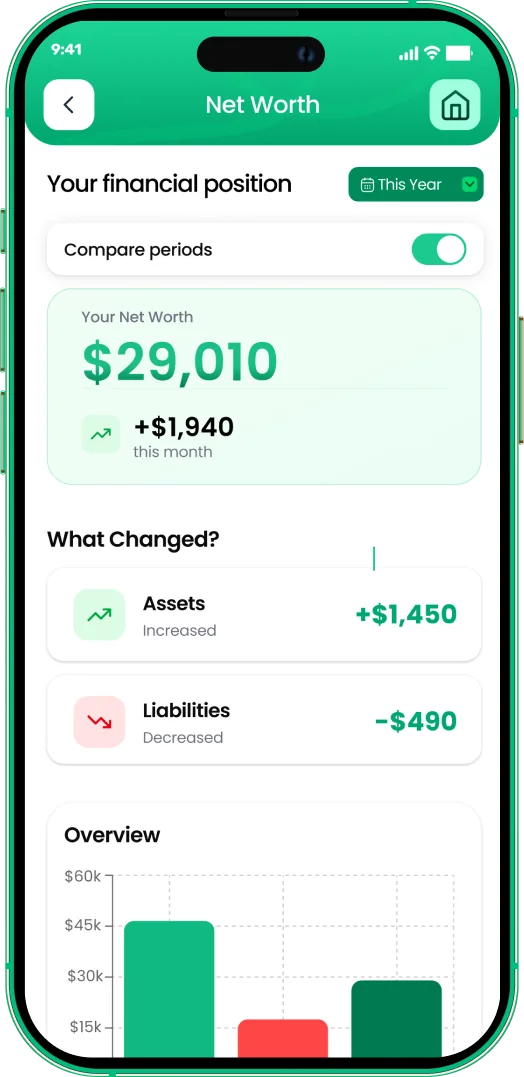
Watch your debt shrink
- Track loans, cards and your mortgage as liabilities
- See what changed each month
- Budget an extra payment into every month


Typical APRs and the legal limit in Canada
Standard Canadian credit cards often charge around 20% on purchases, while low-rate cards charge less and cash advances usually more. Secured loans such as car loans and mortgages typically carry much lower rates because the lender can take back the asset if you stop paying.
Since 1 January 2025, Canada's Criminal Code sets the criminal interest rate at 35% APR, down from a 60% effective annual rate previously. Most loans above that level are illegal, with limited exceptions. High-cost products such as payday loans are also regulated separately by the provinces.
In the United States, the Truth in Lending Act requires lenders to disclose APR in a standard way, and the Consumer Financial Protection Bureau explains the rules. Other countries have similar disclosure requirements.
How to use APR when comparing loans and cards
- Compare like with like. Use APR to compare products of the same type and term. A five-year car loan and a one-year personal loan are not directly comparable.
- Look past the teaser. Promotional balance transfer rates are temporary. Check the APR that applies once the promotion ends and any transfer fee.
- Check what is excluded. Some optional costs, such as creditor insurance or late fees, are not part of APR.
- Pay the highest APR first. When you have several debts, putting extra money toward the one with the highest APR saves the most interest. This is the avalanche method in our guide to debt snowball vs avalanche.
- Protect your credit score. Better credit usually earns lower APRs. See how to improve your credit score in Canada.
Pay it down with EMOH Pay
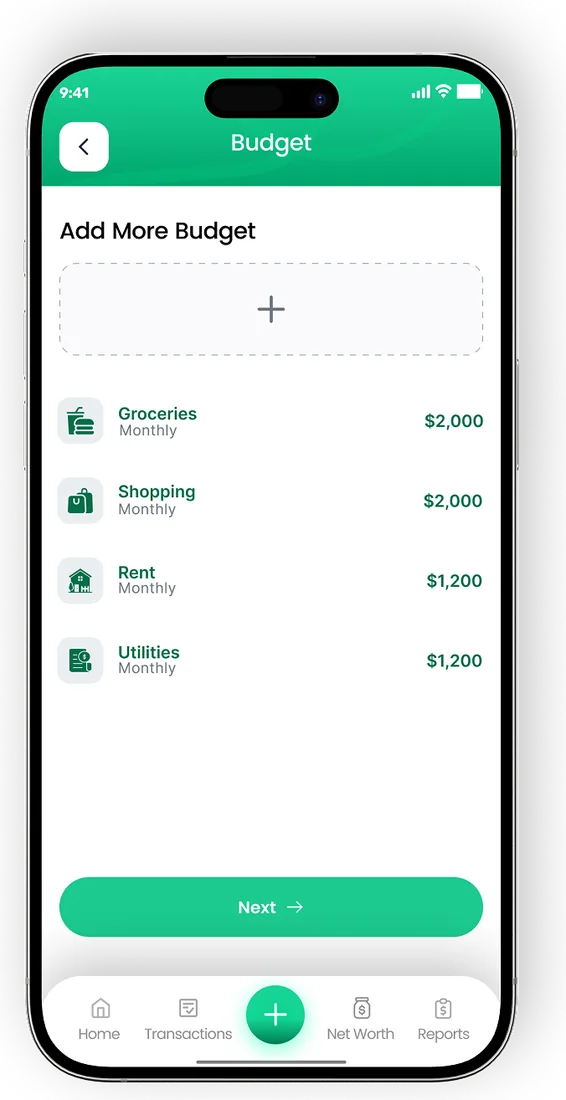
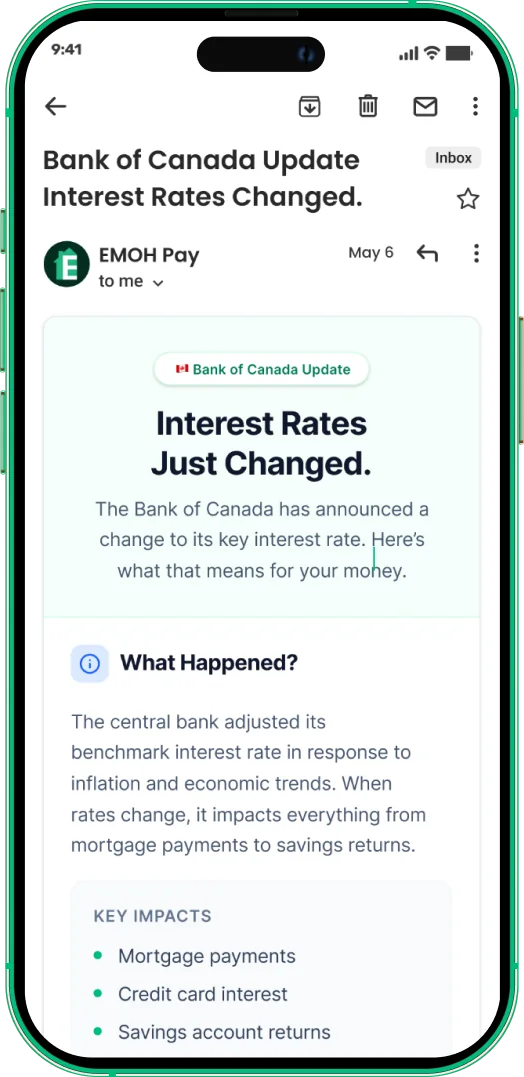
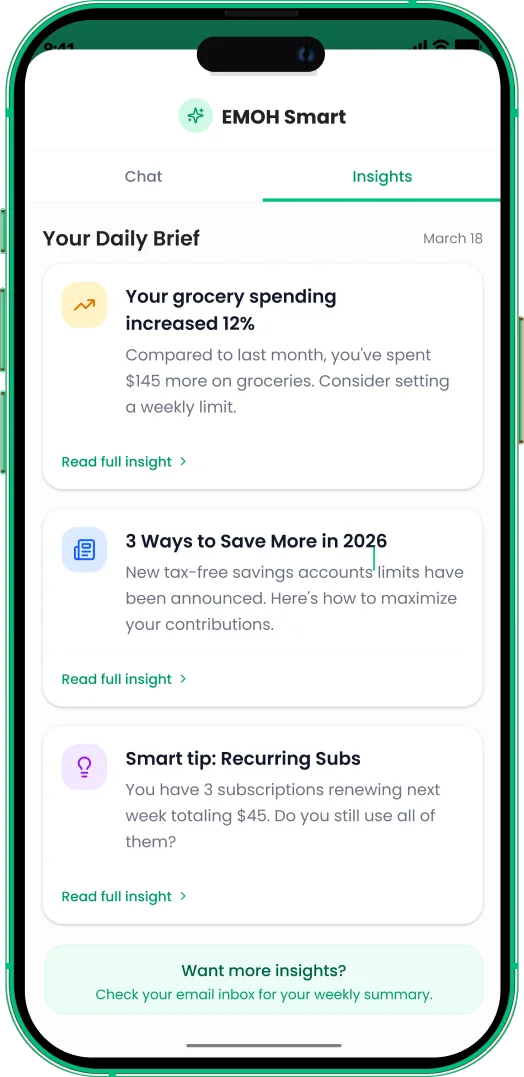
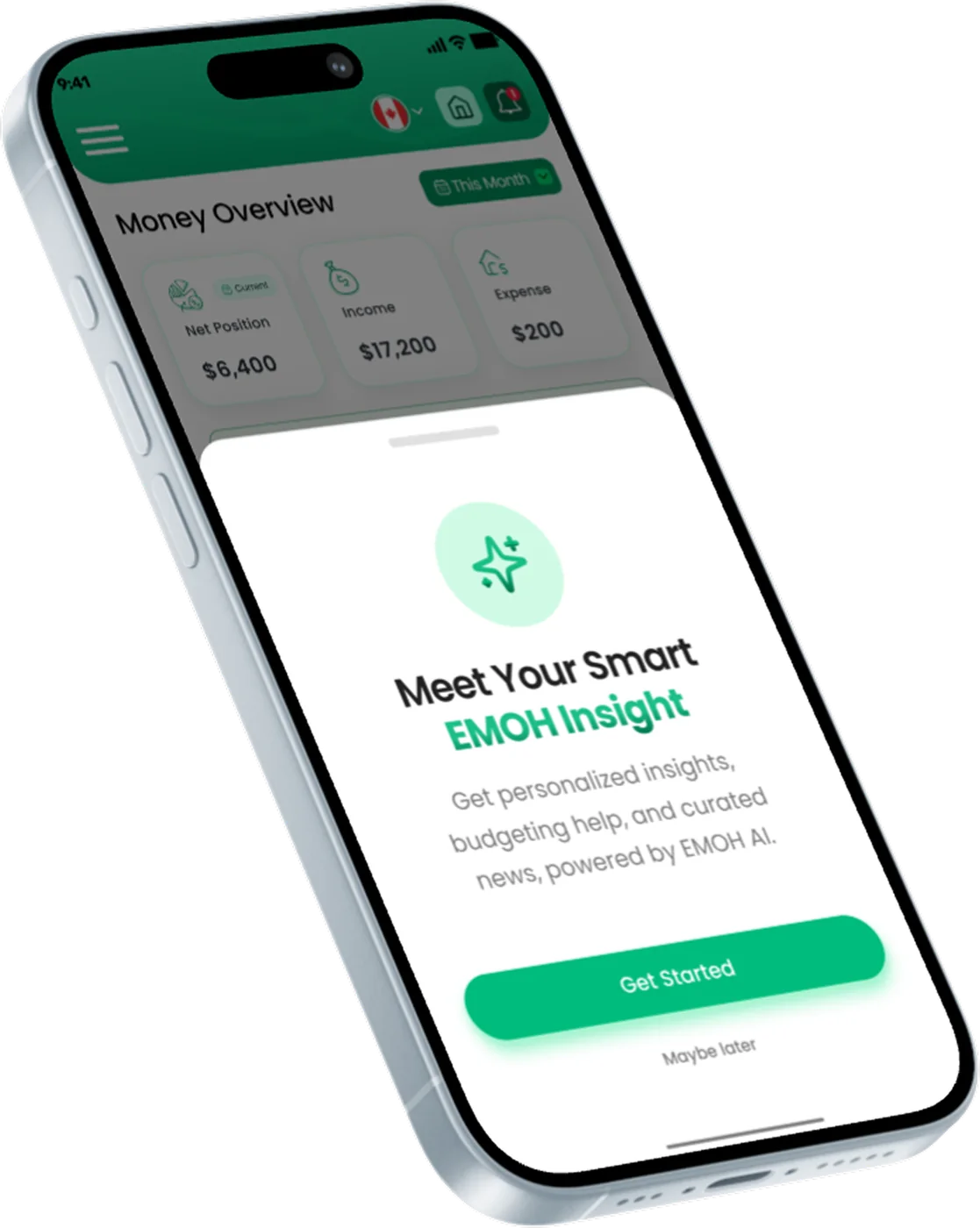
Put the numbers on autopilot
EMOH Pay tracks your spending, budgets and net worth on your phone and in the browser, always in sync. Free to start, made in Canada.
Get started free➜What Is APR?: frequently asked questions
Is a lower APR always better?
For the same type of product and term, yes. But a card with a low APR and a high annual fee can cost more than a no-fee card if you pay in full every month. Only compare APR when you expect to carry a balance.
What is a good APR on a credit card?
Anything well below the roughly 20% that standard Canadian cards often charge is competitive. Low-rate cards exist, usually with fewer rewards. If you pay your balance in full every month, the APR does not affect you.
Does APR include compounding?
No. APR is a simple annual rate. The effective annual rate or APY shows the cost with compounding included, and it is higher than the APR whenever interest is charged more than once a year.
Why is my loan APR higher than the interest rate?
Because APR includes certain required fees, such as an administration or origination fee, spread over the loan term. The shorter the term, the more a fixed fee raises the APR.
How can I see what my credit card APR is costing me?
Check the interest charged on your statement each month. If you record or sync those charges in EMOH Pay, its reports show them alongside your other spending, which makes the cost of carrying a balance easy to see.
Sources and further reading
Related guides and tools
Free credit card interest calculator. Enter your balance, APR and monthly payment to see the total interest you will pay and…
Loan Payment CalculatorFree loan payment calculator: enter the amount, interest rate and term to see your monthly payment, total interest and total…
What Is Compound Interest?What is compound interest? A plain definition, the formula, how compounding frequency changes results, simple vs compound…
Debt Snowball vs Debt AvalancheDebt snowball vs avalanche: see how each debt payoff method works, a worked example with real numbers, which saves more…
How to Pay Off Debt in CanadaTwo proven orders of attack — avalanche saves the most interest, snowball keeps you motivated. Pick one and automate it.…
Money GlossaryA plain-language money glossary: 36 personal finance terms from APR to TFSA, each defined in a sentence or two with links to…
Start free today
Free on iPhone, Android and the web. Upgrade to EMOH Pro anytime for bank sync and advanced AI.
Download for iOS➜ Get it on Android➜