
Rent vs Buy in Canada: How to Decide
Comparing rent with a mortgage payment is the most common mistake. This guide compares the money you never get back in each case, with a worked example and no house price forecasts.
Get started free➜ Download the app➜
Is it better to rent or buy a home in Canada?
Neither is always better. Buying wins financially when the costs you never get back as an owner, such as mortgage interest, property tax, maintenance and the lost return on your down payment, are lower than your rent and you stay long enough to recover closing costs. Otherwise renting and investing the difference often comes out ahead.
Is it better to rent or buy in Canada?
Rent vs buy in Canada has no single answer, because it depends on local prices and rents, interest rates and how long you will stay. The fair test compares unrecoverable costs: rent for a tenant, and interest, property tax, maintenance and the lost return on your down payment for an owner. Mortgage principal is not a cost; it is savings.
Most Canadians do own. Statistics Canada's 2021 Census found 66.5% of households owned their home, down from 69.0% in 2011, while renter households grew more than twice as fast as owner households over that decade. Quebec had the lowest ownership rate among the provinces, at 59.9%. Those numbers describe what people chose, not what is right for you.
Renting vs owning: what you pay in each case
Owning and renting carry different costs, risks and freedoms. The Financial Consumer Agency of Canada notes that renters generally do not pay property tax, home maintenance or real estate fees, and that renting may cost less than buying. Owners build equity and control their home but carry the repair bills and the price risk.
| Item | Renting | Owning |
|---|---|---|
| Upfront cash | First month, any deposit allowed in your province, moving | Down payment plus closing costs of 1.5% to 4% of the price |
| Monthly housing cost | Rent, tenant insurance, some utilities | Mortgage, property tax, home insurance, utilities, condo fees |
| Repairs and maintenance | Usually the landlord's responsibility | Yours; budget for major items such as a roof or furnace |
| Unrecoverable part | All of the rent | Interest, tax, maintenance, insurance, lost investment return |
| Builds wealth through | Investing what you do not spend on housing | Paying down principal and any rise in the home's value |
| Flexibility | Move at the end of a lease | Selling costs time and money |
| Main risk | Rent increases and not being able to renew | Rate rises at renewal, repairs and falling prices |
What is the 5% rule for rent vs buy?
The 5% rule is a rule of thumb, not an official figure: multiply the home's price by 5% and divide by 12 to estimate an owner's monthly unrecoverable cost. If you can rent a similar home for less, renting and investing the difference is likely the better financial choice. If rent is higher, buying likely is.
The 5% is usually split into about 1% for property tax, 1% for maintenance and 3% for the cost of capital, meaning mortgage interest plus the return you give up on your down payment. Change any part to match your situation. Property tax rates differ widely between cities, and the cost of capital rises with mortgage rates.
| Home price | 5% a year | Monthly break-even rent |
|---|---|---|
| $400,000 | $20,000 | about $1,667 |
| $600,000 | $30,000 | about $2,500 |
| $800,000 | $40,000 | about $3,333 |
| $1,000,000 | $50,000 | about $4,167 |
Compare the break-even figure with what similar homes actually rent for in your area. Our average rent in Canada page shows current rents by city.
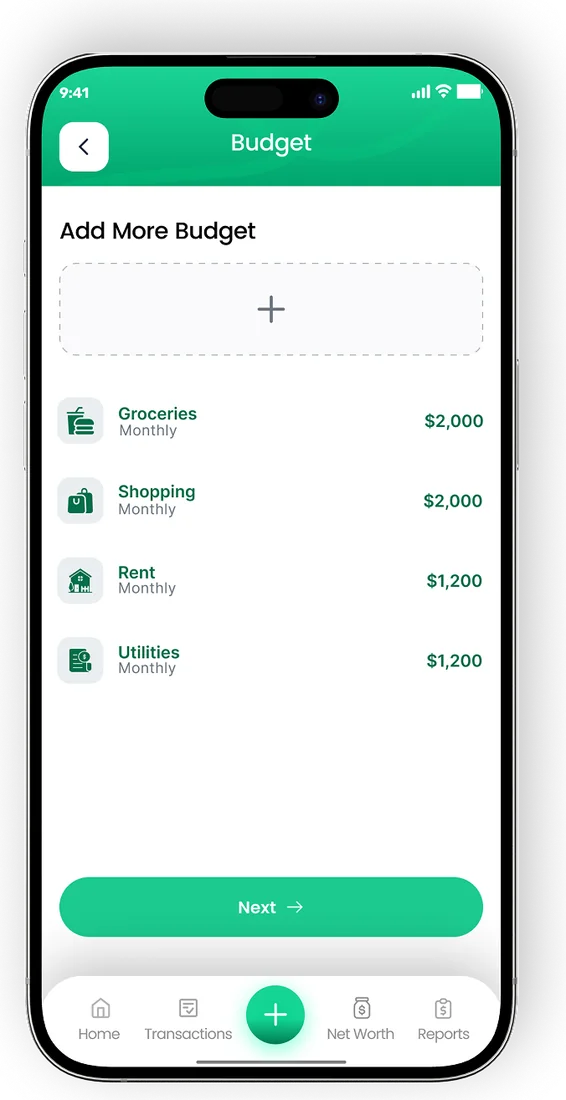
Budgets that update themselves
- Set monthly limits for every category
- See what is left to spend in real time
- Get a nudge before a category runs out


A worked rent vs buy example with real arithmetic
Using your own numbers instead of the 5% shortcut gives a sharper answer. In this example a family compares a $600,000 townhouse with renting a similar one for $2,600 a month. Every rate below is an assumption chosen to show the method, not a forecast. Swap in your own.
- Interest: $480,000 × 0.045 = $21,600 (slightly less in practice, because Canadian mortgages compound semi-annually and principal falls during the year).
- Add the other owner costs: $21,600 + $6,000 + $6,000 + $4,800 + $1,200 + $2,000 = $41,600.
- Monthly unrecoverable cost of owning: $41,600 ÷ 12 = about $3,467.
- Monthly unrecoverable cost of renting: $2,600.
- Gap: $3,467 − $2,600 = about $867 a month in favour of renting, if the family invests the difference and the down payment.
| Cost | Assumption | Year one |
|---|---|---|
| Mortgage interest | $480,000 mortgage (20% down) at 4.5% | about $21,600 |
| Property tax | 1% of value | $6,000 |
| Maintenance | 1% of value | $6,000 |
| Lost return on down payment | $120,000 at 4% after tax | $4,800 |
| Extra insurance | home insurance minus tenant insurance | $1,200 |
| Closing costs spread out | $14,000 over 7 years | $2,000 |
| Total | about $41,600, or $3,467 a month |
Buying would come out ahead if rent for the same home were above about $3,467, if the mortgage rate were lower, or if the family stayed long enough for any rise in value to outweigh the gap. This page does not predict house prices, so treat appreciation as an unknown and test a range. The calculation also only works if the renter really does invest the difference rather than spend it.
Example figures are illustrative assumptions. Closing costs and ownership figures checked October 2026 with the Financial Consumer Agency of Canada and Statistics Canada.
Is there a rent or buy calculator?
Yes. A rent or buy calculator runs the same comparison as the example above over several years. The Government of Canada lists free mortgage and affordability tools on its financial tools page, and any good calculator should ask for the home price, rent, mortgage rate, property tax, maintenance, investment return and years you plan to stay.
Before you use one, pin down two inputs. First, how much you could borrow and still sleep at night, which our mortgage affordability calculator estimates. Second, the cash you need on day one: the minimum down payment plus closing costs in Canada.
Questions to answer before you decide
If you lean toward buying but are not ready, renting while you save is a plan, not a failure. A First Home Savings Account lets you save for a down payment with tax advantages; our guide to what an FHSA is explains the rules. EMOH Pay can hold a down-payment goal and track your rent as a bill, so you see both sides of the decision each month.
- How long will you stay? Closing costs and selling costs make short stays expensive. Buying rarely pays off if you might move within a few years.
- Is your income stable? Owners cannot hand in a notice when money gets tight. A solid emergency fund matters more for owners than renters.
- Will you invest the difference? Renting only wins if the money you save goes into a TFSA, RRSP or FHSA rather than daily spending.
- Can you handle a repair bill? A furnace or roof replacement arrives without warning.
- What do you value? Control over renovations, pets and stability on one side; freedom to move and no maintenance on the other.
Plan your month in EMOH Pay
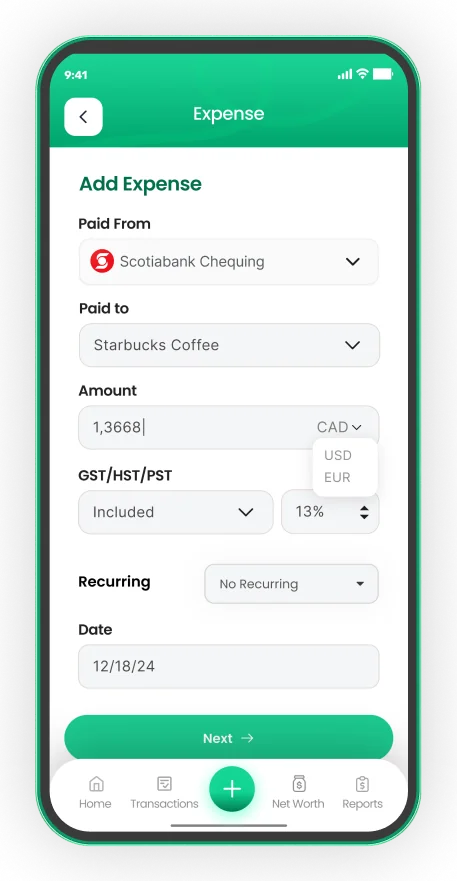
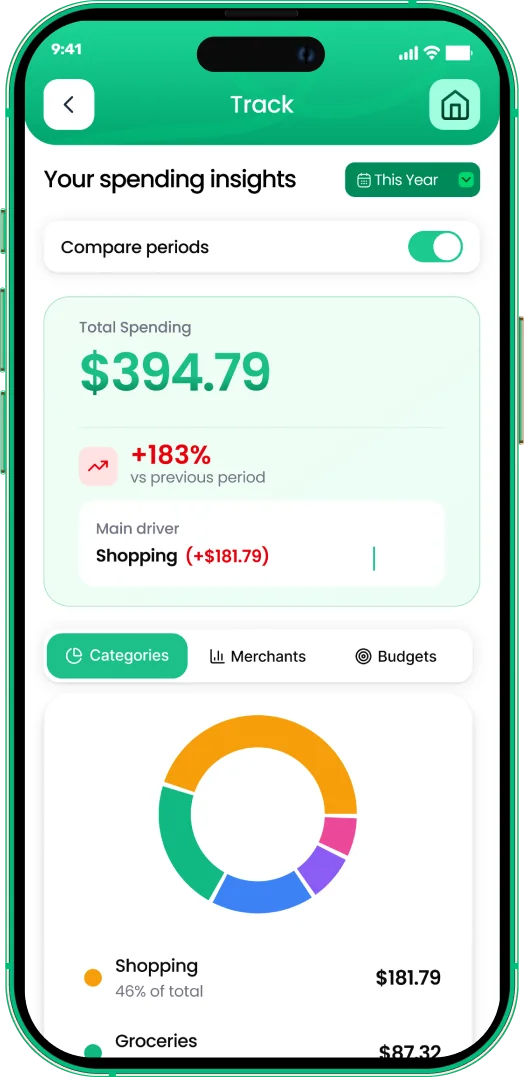
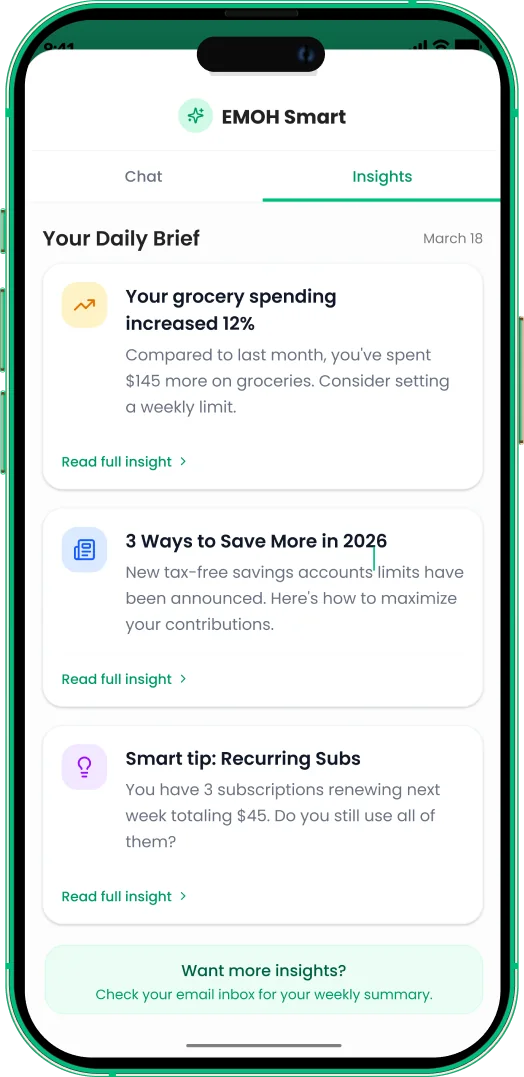

Put the numbers on autopilot
EMOH Pay tracks your spending, budgets and net worth on your phone and in the browser, always in sync. Free to start, made in Canada.
Get started free➜Rent vs Buy in Canada: How to Decide: frequently asked questions
Is renting a waste of money?
No. Rent buys a place to live, flexibility and freedom from repairs. Owners also pay money they never get back, through interest, property tax, maintenance and the return they give up on the down payment. The fair comparison is unrecoverable cost against unrecoverable cost.
Should I compare rent with my mortgage payment?
No. A mortgage payment includes principal, which you keep as equity, but it leaves out property tax, maintenance and the cost of tying up your down payment. Compare rent with the owner's unrecoverable costs instead.
How long do I need to stay for buying to make sense?
Long enough to recover closing costs of 1.5% to 4% of the price, plus the costs of selling later. For most buyers that means several years. Run the comparison with the number of years you realistically expect to stay.
Does the 5% rule work everywhere in Canada?
It is a starting point. Property tax, maintenance and mortgage rates vary by city and over time, so adjust each of the three parts. A low property tax city or a newer home can push the figure below 5%, while higher rates push it up.
Is it better to rent or buy in Quebec?
The same method applies. Quebec has the lowest homeownership rate among the provinces, at 59.9% in 2021, and buyers pay municipal transfer duties, often called the welcome tax, as part of closing costs.
Related guides and tools
Average rent in Canada for 2026: typical one-bedroom ranges in 20 cities, why survey and asking rents differ, and how to…
Closing Costs in Canada: What to BudgetClosing costs in Canada run 1.5% to 4% of the purchase price. See land transfer tax by province, an itemised list and a…
Minimum Down Payment in CanadaThe minimum down payment in Canada is 5% on the first $500,000, 10% on the rest up to $1.5 million and 20% above. See worked…
Mortgage Affordability Calculator CanadaMortgage affordability calculator for Canada: see the home price you could qualify for under the stress test, then check…
Rent Affordability CalculatorThe classic rule: keep rent at or under 30% of gross monthly income (35% of take-home in expensive cities). Enter your…
First-Time Home Buyer Programs in Canada (2026)First time home buyer Canada guide for 2026: the FHSA, the $60,000 Home Buyers' Plan, the $10,000 tax credit, the new-home…
Start free today
Free on iPhone, Android and the web. Upgrade to EMOH Pro anytime for advanced AI and unlimited family sharing.
Download for iOS➜ Get it on Android➜