
Minimum Down Payment in Canada
You need 5% of the first $500,000, 10% of the portion from $500,000 to $1.5 million, and 20% on homes of $1.5 million or more. Put down less than 20% and you also pay mortgage loan insurance.
Get started free➜ Download the app➜
How much do you need for a down payment in Canada?
In Canada you need at least 5% of the purchase price for a home of $500,000 or less. For homes from $500,000 to $1.5 million you need 5% of the first $500,000 plus 10% of the rest. Homes of $1.5 million or more need 20%. With less than 20% down, you must buy mortgage loan insurance.
What is the minimum down payment in Canada?
The minimum down payment in Canada depends on the purchase price. It is 5% on a home of $500,000 or less. Between $500,000 and $1.5 million, it is 5% of the first $500,000 plus 10% of the portion above $500,000. At $1.5 million or more, it is 20% of the full price. These are federal rules for every province.
The middle tier was widened on December 15, 2024, when the federal government raised the price cap for insured mortgages from $1 million to $1.5 million. Before that, any home of $1 million or more needed 20% down. On a $1.4 million home, the change cut the minimum down payment by up to $165,000.
| Purchase price | Minimum down payment |
|---|---|
| $500,000 or less | 5% of the purchase price |
| $500,000 to $1.5 million | 5% of the first $500,000 plus 10% of the portion above $500,000 |
| $1.5 million or more | 20% of the purchase price |
Figures checked October 2026; confirm current rules with the Financial Consumer Agency of Canada and CMHC.
How much down payment for a house in Canada? Examples by price
To work out how much down payment you need for a house in Canada, take 5% of the price up to $500,000, then add 10% of anything between $500,000 and $1.5 million. On a $600,000 home that is $25,000 plus $10,000, or $35,000. The table shows the minimum at common prices.
| Purchase price | Calculation | Minimum down payment | Share of price |
|---|---|---|---|
| $300,000 | 5% of $300,000 | $15,000 | 5% |
| $400,000 | 5% of $400,000 | $20,000 | 5% |
| $500,000 | 5% of $500,000 | $25,000 | 5% |
| $600,000 | $25,000 + 10% of $100,000 | $35,000 | 5.8% |
| $750,000 | $25,000 + 10% of $250,000 | $50,000 | 6.7% |
| $900,000 | $25,000 + 10% of $400,000 | $65,000 | 7.2% |
| $1,200,000 | $25,000 + 10% of $700,000 | $95,000 | 7.9% |
| $1,500,000 | 20% of $1,500,000 | $300,000 | 20% |
The minimum is only the floor. Lenders can ask for more, for example if you are self-employed or have a weak credit history. To see what price your income supports, use the mortgage affordability calculator.
What is CMHC insurance and how much does it cost?
CMHC insurance, or mortgage loan insurance, protects your lender if you stop paying. You must buy it when your down payment is under 20%. The premium is a percentage of the mortgage, and the smaller your down payment, the higher the rate. CMHC, Sagen and Canada Guaranty all offer it.
Most buyers add the premium to the mortgage and pay interest on it over the life of the loan. Some provinces, including Ontario and Quebec, charge provincial sales tax on the premium, and that tax cannot be added to the mortgage. You pay it at closing.
The premium is a percentage of the mortgage amount, and the percentage is higher when the down payment is smaller. CMHC and the other mortgage insurers publish the current rates, so check them on the CMHC mortgage loan insurance page before you plan around a number.
Insurance is mandatory only below 20% down, but lenders sometimes insure larger down payments. CMHC adds a premium surcharge for amortizations longer than 25 years, and non-traditional down payment sources can carry a higher rate. Confirm the current premium with your lender or CMHC before you budget.
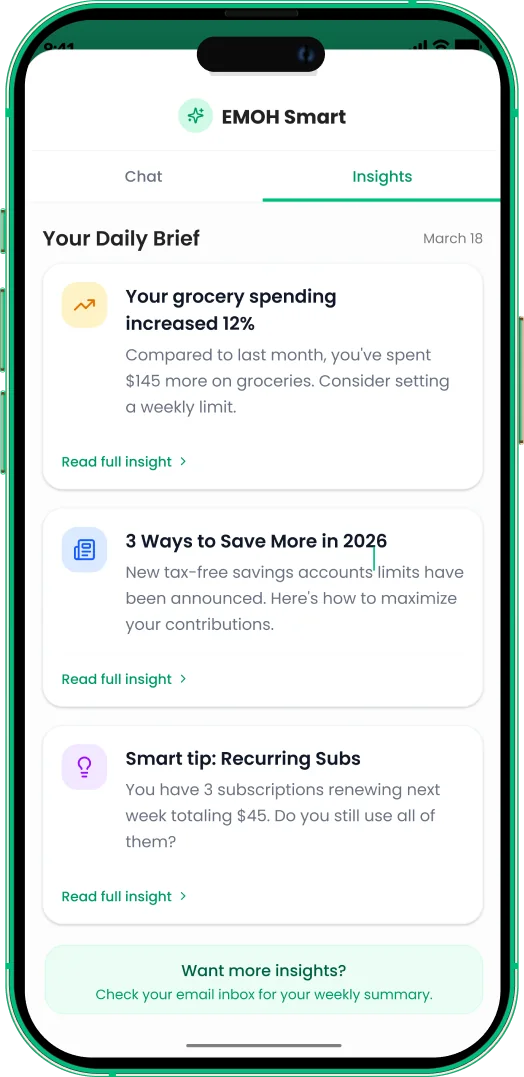
Tips that help you save
- A daily brief with practical ways to save
- Spot recurring subscriptions worth cutting
- Watch your savings show up in your net worth


Worked example: the real cost of 5%, 10% and 20% down
On a $400,000 home, the size of your down payment changes both the mortgage and the insurance premium. The Financial Consumer Agency of Canada uses this example with a 4% interest rate and a 25-year amortization, with the premium added to the mortgage.
- 5% down is $20,000, so the loan is $380,000 and insurance is required. With the premium added, FCAC's example mortgage is $395,200.
- 10% down is $40,000, so the loan is $360,000 and insurance is required. With the premium added, FCAC's example mortgage is $371,160.
- 20% down is $80,000. The loan is $320,000 and no insurance is required. Total mortgage: $320,000.
Going from 5% to 20% down saves about $58,700 over 25 years in this example. Whether waiting is worth it depends on how fast you can save and how prices move in your area, which the rent vs buy guide helps you weigh.
What are the down payment rules in Canada?
The main down payment rules in Canada are that the minimum must normally come from your own funds, insured mortgages are only available on homes under $1.5 million, and the maximum amortization on an insured mortgage is 25 years, or 30 years for first-time buyers and buyers of new builds.
- Own funds. Savings, investments and registered plans count. Lenders want proof the money has been in your account for a period, or a gift letter if family is helping.
- Registered plans. You can use a First Home Savings Account and up to $60,000 per person from your RRSP under the Home Buyers' Plan. See first-time home buyer programs in Canada and what is an FHSA.
- Price cap. Homes of $1.5 million or more cannot be insured, so they need 20% down.
- 30-year amortization. Since December 15, 2024, first-time buyers and buyers of new builds can choose 30 years on an insured mortgage, which lowers the payment but adds interest and a higher premium.
- Closing costs are extra. Land transfer tax, legal fees and inspections are not part of the down payment. Budget for them separately using the guide to closing costs in Canada.
How to save your down payment
Saving for a down payment usually takes years, so a fixed monthly target helps. Divide the amount you need by the months until you want to buy, then automate that transfer on payday. The savings goal calculator does the arithmetic, and how to save for a house in Canada covers where to keep the money.
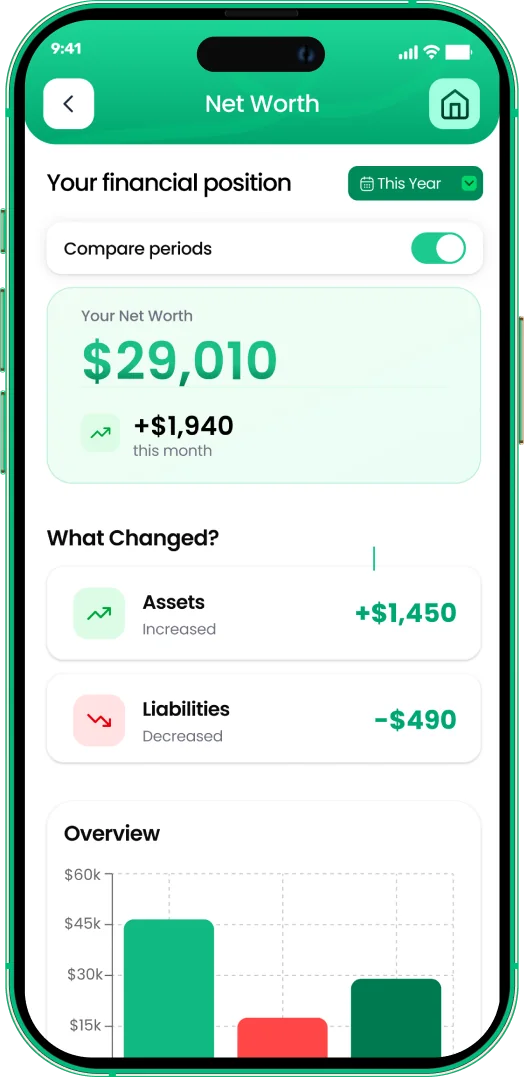
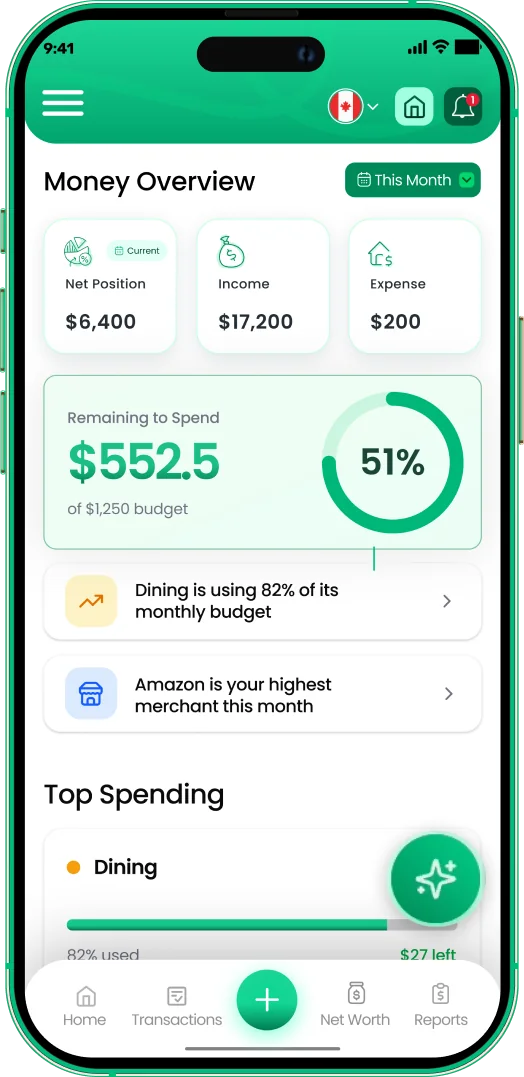
In EMOH Pay you can set a down payment savings goal, track it next to your budget and see your net worth climb as the fund grows. Watching the gap shrink each month makes it easier to keep going.
Save more with EMOH Pay
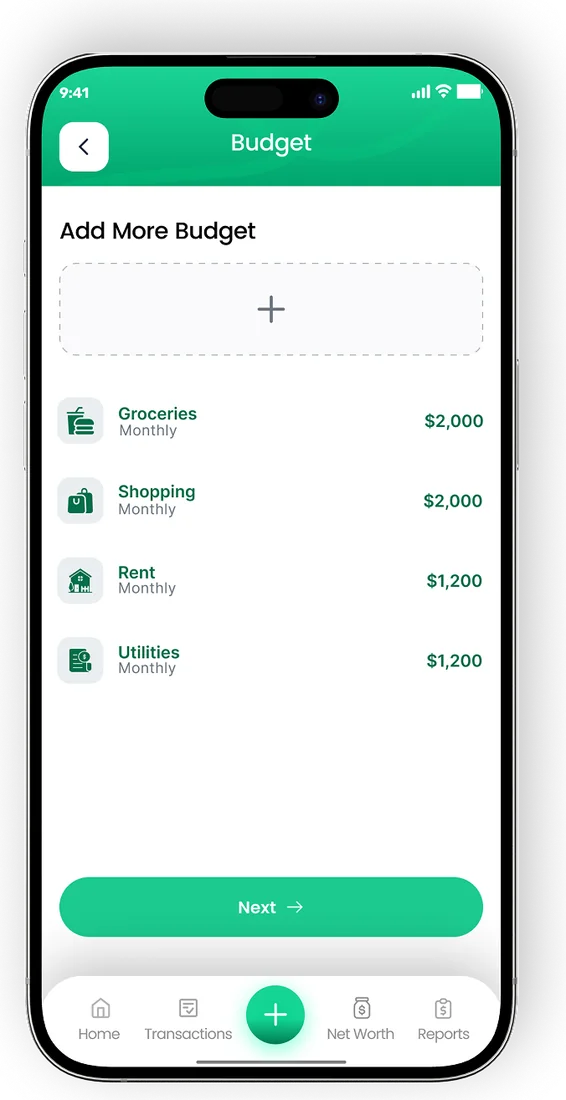

Put the numbers on autopilot
EMOH Pay tracks your spending, budgets and net worth on your phone and in the browser, always in sync. Free to start, made in Canada.
Get started free➜Minimum Down Payment in Canada: frequently asked questions
Can I buy a house in Canada with 5% down?
Yes, on a home of $500,000 or less. Above $500,000 the minimum rises because 10% applies to the portion over $500,000, and with under 20% down you must pay mortgage loan insurance.
What is the minimum down payment on a $1 million home?
$75,000: 5% of the first $500,000 is $25,000, and 10% of the remaining $500,000 is $50,000. With 7.5% down, you would need mortgage loan insurance.
Do I need 20% down for a second home or rental?
Rules differ for properties you will not live in, and lenders often ask for more on rentals. Check with your lender, since the 5% minimum generally applies to an owner-occupied home.
Can a gift be used for a down payment?
Often yes. Many lenders accept a gift from close family with a signed letter confirming it does not have to be repaid. Requirements vary by lender and insurer.
Is the CMHC premium paid upfront?
Usually not. Most buyers add the premium to the mortgage. Any provincial sales tax on the premium, charged in provinces including Ontario and Quebec, must be paid at closing.
Related guides and tools
Mortgage affordability calculator for Canada: see the home price you could qualify for under the stress test, then check…
First-Time Home Buyer Programs in Canada (2026)First time home buyer Canada guide for 2026: the FHSA, the $60,000 Home Buyers' Plan, the $10,000 tax credit, the new-home…
How to Save for a House in CanadaHow to save for a house in Canada: work out your down payment, use the FHSA, RRSP and TFSA, budget for closing costs and…
Closing Costs in Canada: What to BudgetClosing costs in Canada run 1.5% to 4% of the purchase price. See land transfer tax by province, an itemised list and a…
Rent vs Buy in Canada: How to DecideRent vs buy in Canada comes down to unrecoverable costs, not rent versus mortgage. Use the 5% rule, a worked example and a…
What Is an FHSA?What is an FHSA? A plain-language guide to Canada's First Home Savings Account: who qualifies, the $8,000 yearly limit…
Start free today
Free on iPhone, Android and the web. Upgrade to EMOH Pro anytime for advanced AI and unlimited family sharing.
Download for iOS➜ Get it on Android➜