
Compound Interest Calculator
Enter what you have, what you add each month, an expected return and a timeline. See your future balance, how much you contributed and how much came from growth.
Use the calculator➜ Try EMOH Pay free➜
How much will my savings grow?
Your savings grow by your contributions plus interest earned on both the money you put in and the interest already added. For example, $5,000 plus $200 a month at a 6% annual return, compounded monthly, grows to about $108,959 in 20 years. You contribute $53,000; the other $55,959 is compound growth.
How this compound interest calculator works
The compound interest calculator adds interest to your balance every month, then earns interest on that larger balance the next month. Over time, the interest starts earning interest of its own. That snowball is what makes long timelines so powerful.
Four inputs drive the result. Change any one of them to see how much it matters.
- Starting amount: what you have saved or invested today.
- Monthly contribution: what you plan to add each month. Enter 0 to see a lump sum grow on its own.
- Annual return (%): the yearly interest rate or expected investment return. The calculator divides it by 12 and compounds monthly.
- Years: how long the money stays invested.
The results show your final balance, the total you contributed and the growth from interest, plus a table at 5-year steps. The maths works the same in any currency, so you can enter amounts in dollars, pounds, rupees or anything else.
Savings growth example: $5,000 plus $200 a month
Here is how $5,000 with $200 added every month grows at a 6% annual return. In the early years, most of the balance is your own money. By year 20, growth from interest is larger than everything you contributed.
| Year | Total contributed | Balance | Growth from interest |
|---|---|---|---|
| 5 | $17,000 | $20,698 | $3,698 |
| 10 | $29,000 | $41,873 | $12,873 |
| 15 | $41,000 | $70,434 | $29,434 |
| 20 | $53,000 | $108,959 | $55,959 |
| 25 | $65,000 | $160,924 | $95,924 |
| 30 | $77,000 | $231,016 | $154,016 |
How much does the rate of return change the result?
The rate matters a lot over long periods. Using the same $5,000 start and $200 a month for 20 years, each extra two percentage points adds tens of thousands of dollars. That is why fees and the type of account you use deserve attention.
| Annual return | Balance after 20 years | Growth from interest |
|---|---|---|
| 2% | $66,416 | $13,416 |
| 4% | $84,468 | $31,468 |
| 6% | $108,959 | $55,959 |
| 8% | $142,438 | $89,438 |
Returns are not guaranteed. A savings account or GIC pays a stated rate, while stock and bond investments can rise or fall from year to year. Use a conservative rate for planning and test a lower one to see a cautious outcome.
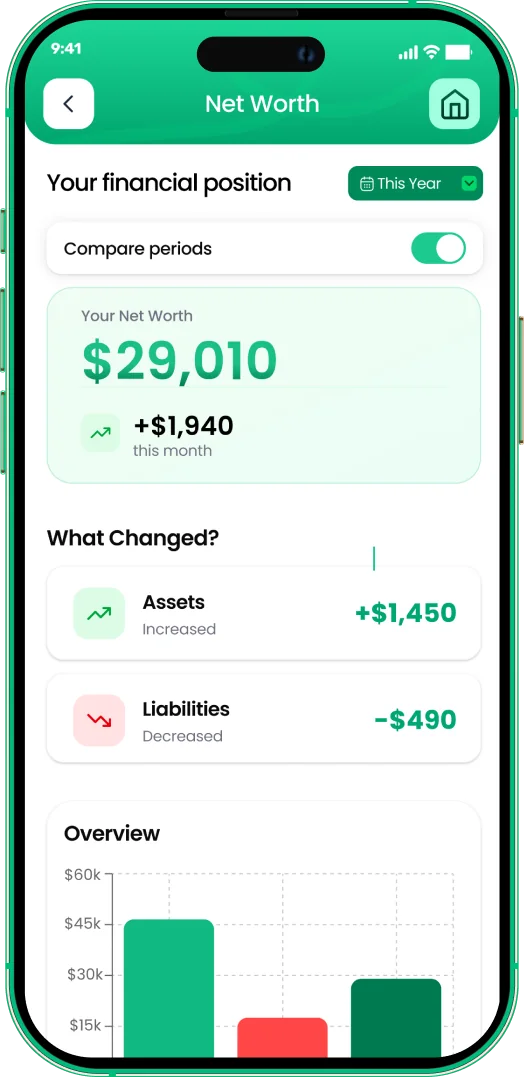
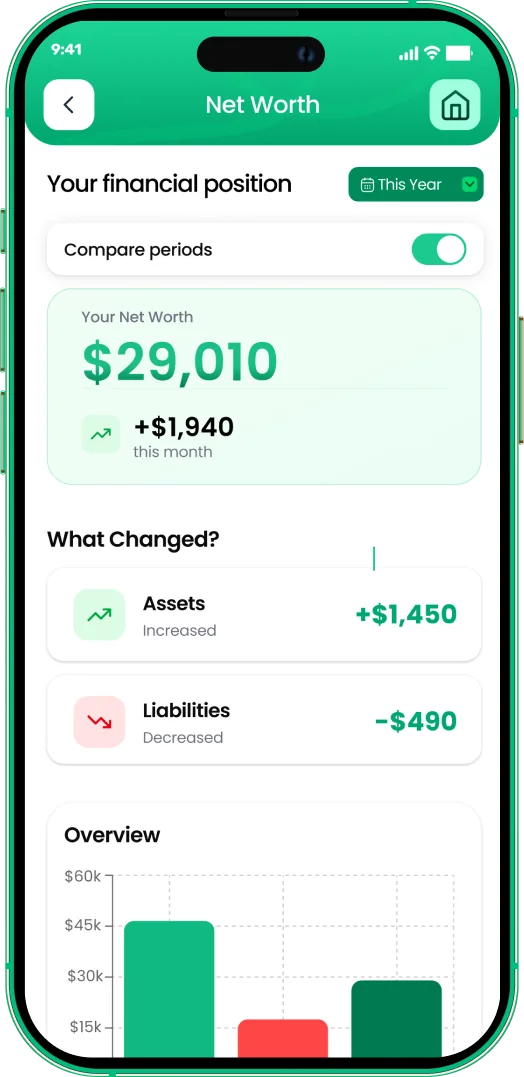
Watch your net worth grow
- Add assets and debts in any of 148 currencies
- See what changed month by month
- Set savings goals and track progress


Why starting early matters
Time is the biggest driver of compound growth. Someone saving $300 a month at 6% for 35 years ends up with about $427,000, having contributed $126,000. Saving the same amount for 15 years gives about $87,000 from $54,000 in contributions. The extra 20 years lifts the growth from about $33,000 to about $301,000.
| Years saving | Total contributed | Balance |
|---|---|---|
| 15 | $54,000 | $87,246 |
| 25 | $90,000 | $207,898 |
| 35 | $126,000 | $427,413 |
A quick way to estimate doubling time is the rule of 72: divide 72 by the annual return. At 6%, money doubles in about 12 years. Try it with the rule of 72 calculator.
Compounding frequency: monthly, daily or yearly
The more often interest is added, the slightly faster money grows. $10,000 at 5% for 10 years grows to about $16,289 with yearly compounding, $16,470 with monthly compounding and $16,487 with daily compounding. The difference is real but small next to the effect of time, rate and contributions.
For a plain-language explanation of how interest on interest works, read our guide to what compound interest is.
Making compound interest work for you
- Automate a monthly contribution on payday, even a small one.
- Use a tax-sheltered account where you can. Growth in a TFSA is tax-free. Check the 2026 TFSA limit for your room.
- Keep fees low, because they reduce your return every year.
- Factor in inflation. The Bank of Canada targets 2% inflation, so a 6% return is closer to 4% in today's money. The inflation calculator shows how prices change over time.
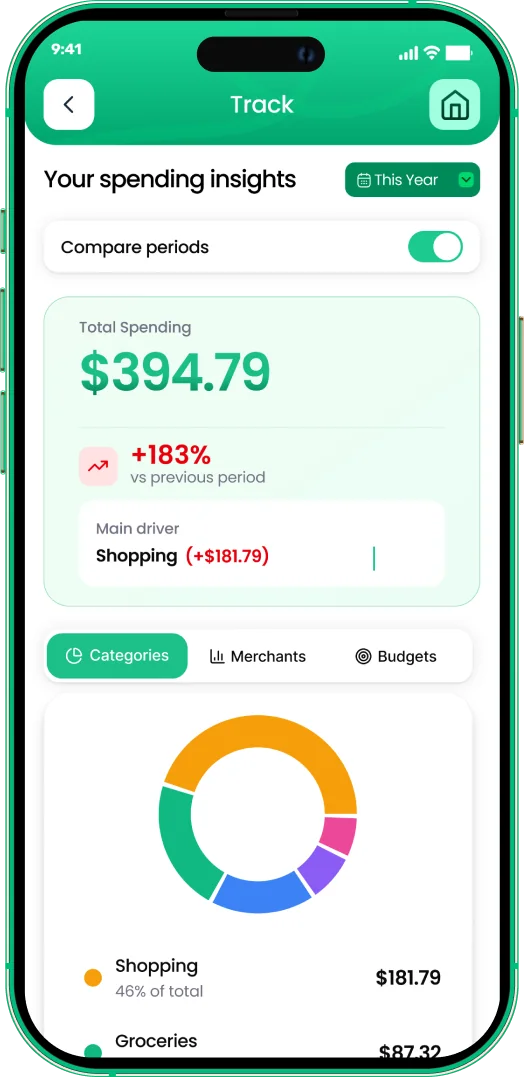
- Track the goal. Set a savings goal in EMOH Pay and watch your net worth grow alongside your budgets. See all EMOH Pay features.
Compound interest also works against you on debt. A credit card balance grows the same way, which is why the credit card interest calculator is worth a look if you carry a balance.
Your net worth in EMOH Pay
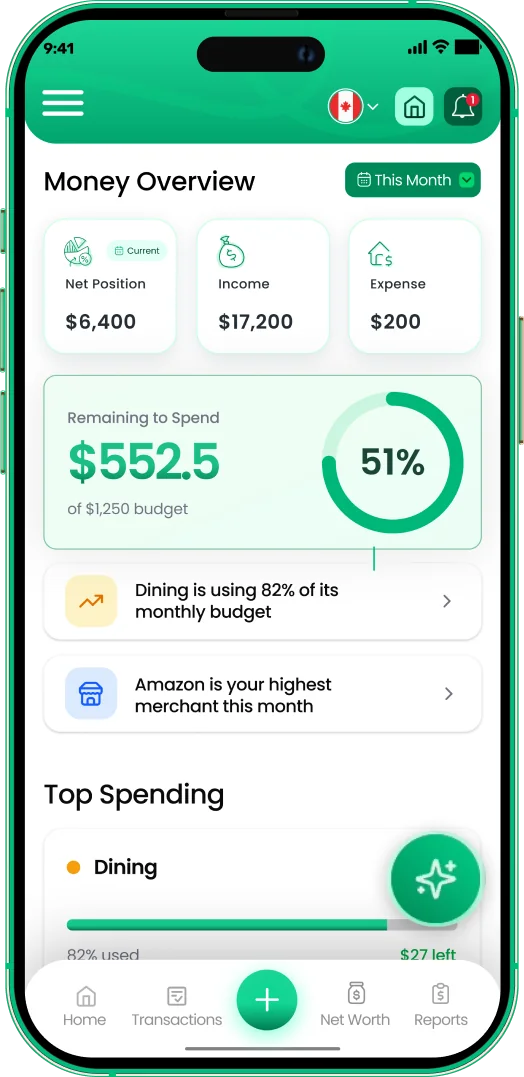

Put the numbers on autopilot
EMOH Pay tracks your spending, budgets and net worth on your phone and in the browser, always in sync. Free to start, made in Canada.
Get started free➜Compound Interest Calculator: frequently asked questions
What is the formula for compound interest?
For a lump sum, the future value is P × (1 + r/n)^(n × t), where P is the starting amount, r is the annual rate, n is the number of compounding periods per year and t is the number of years. Regular contributions add a second term, which this calculator includes.
Does the calculator compound monthly or yearly?
Monthly. It divides your annual return by 12 and adds interest each month, which matches how most savings accounts and regular investment plans work.
What return should I use?
Use the stated rate for a savings account or GIC. For investments, pick a conservative long-term assumption and test a lower rate too. Past returns do not guarantee future ones.
Does the result include tax or inflation?
No. The result is before tax and in future dollars. Growth inside a TFSA is not taxed, and you can subtract expected inflation from the return to see the result in today's money.
Can I use it for other currencies?
Yes. The calculation is the same in any currency. Enter your amounts in the currency you save in.
Related guides and tools
What is compound interest? A plain definition, the formula, how compounding frequency changes results, simple vs compound…
Rule of 72 CalculatorUse the rule of 72 to see how long your money takes to double at any interest rate or return, compared with the exact answer…
Savings Goal Calculator — Free CalculatorHow much to save per month? Enter your target amount and months until deadline — get your required monthly contribution…
Retirement Savings CalculatorFree retirement savings calculator: project your nest egg at retirement, compare it with a 25-times-spending target and see…
TFSA Contribution Room CalculatorTFSA contribution room calculator: enter the year you turned 18, what you have contributed and withdrawn, and see how much…
Inflation Calculator CanadaInflation calculator for Canada: see what a dollar amount from any year since 2000 is worth today, using Statistics Canada…
Start free today
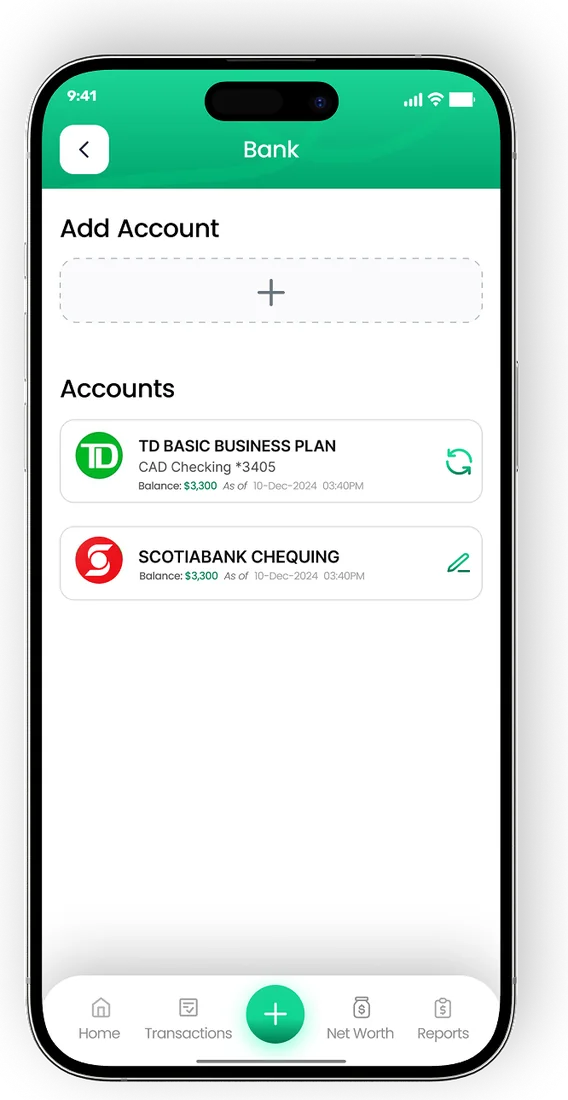
Free on iPhone, Android and the web. Upgrade to EMOH Pro anytime for bank sync and advanced AI.
Download for iOS➜ Get it on Android➜