
Capital Gains Tax in Canada
Canada taxes half of a capital gain at your regular income tax rate. Here is how to work out the gain, what it costs at different incomes and the exemptions that can reduce it to zero.
Get started free➜ Download the app➜
How is capital gains tax calculated in Canada?
Capital gains tax in Canada is calculated by subtracting your adjusted cost base and selling costs from the sale price, then adding half of that gain to your income. The taxable half is taxed at your normal marginal rate. A $10,000 gain adds $5,000 to taxable income, costing about $1,500 at a 30% marginal rate.
How capital gains tax in Canada works
Capital gains tax in Canada is not a separate tax. When you sell an investment or property for more than you paid, half of the profit is added to your income for the year and taxed along with your salary and other income. The other half is tax-free.
You only pay tax when you sell, or are treated as having sold, an asset. A stock that doubles in value but that you still hold creates no tax bill. Gains are reported on Schedule 3 of your return, due by the tax filing deadline of 30 April the following year.
What is the capital gains inclusion rate?
The capital gains inclusion rate is the share of a gain that is taxable, and it is 50% in Canada. A proposal to raise it to two-thirds on gains above $250,000 was announced in 2024 but cancelled in March 2025, so the 50% rate continues to apply to individuals, corporations and trusts.
Because only half the gain is taxed, the effective rate on a capital gain is half your marginal rate. For an Ontario resident in the top bracket, the top combined rate of 53.53% becomes about 26.76% on a capital gain.
| Combined marginal rate | Taxable portion | Tax owed | Effective rate on gain |
|---|---|---|---|
| 20% | $5,000 | $1,000 | 10% |
| 30% | $5,000 | $1,500 | 15% |
| 40% | $5,000 | $2,000 | 20% |
| 53.53% (top rate, Ontario) | $5,000 | $2,677 | 26.8% |
Your marginal rate depends on your total income and province. See tax brackets Canada 2026 for the federal rates and Ontario tax brackets for an example of a provincial schedule.
How to calculate a capital gain step by step
Example: you buy 100 shares at $50, paying $10 in commission, for an ACB of $5,010. Years later you sell them at $80, paying another $10. Proceeds of $8,000 minus $5,010 minus $10 gives a gain of $2,980. Half, $1,490, is taxable. At a combined marginal rate of 29.65%, the tax is about $442. Keeping trade confirmations with your records, for example as receipts in EMOH Pay, makes the ACB easy to rebuild later.
- Work out the proceeds of disposition: the sale price.
- Work out the adjusted cost base (ACB): what you paid, including commissions and other acquisition costs. For shares bought at different times, the ACB is the average cost per share.
- Subtract selling costs, such as commissions or legal fees.
- Proceeds minus ACB minus selling costs is your capital gain, or loss if negative.
- Multiply the gain by 50% to find the taxable capital gain, and add it to your income.
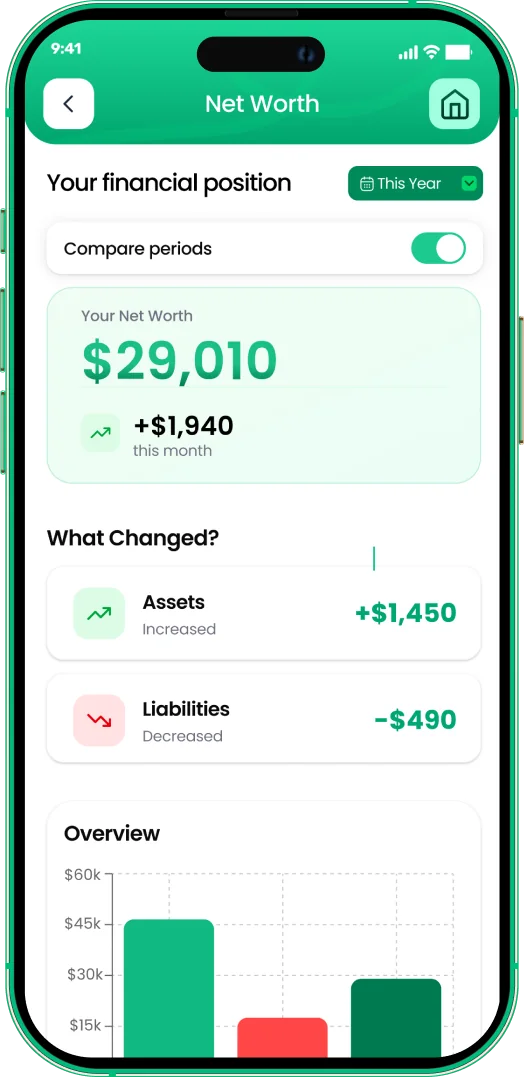
Watch your net worth grow
- Add assets and debts in any of 148 currencies
- See what changed month by month
- Set savings goals and track progress


Capital gains exemptions and tax-free accounts
Several rules can reduce capital gains tax to zero. The most important for most households is the principal residence exemption.
- Principal residence exemption. A gain on the home you live in is generally tax-free for each year it was your principal residence. You must still report the sale on your return.
- TFSA. Gains inside a TFSA are never taxed, even on withdrawal. The TFSA limit for 2026 is $7,000.
- RRSP and RRIF. Gains are not taxed inside the plan, but withdrawals are taxed as regular income, not as capital gains.
- Lifetime capital gains exemption. Up to $1.25 million of gains on qualified small business shares and qualified farm or fishing property can be exempt.
- Donating securities. Giving publicly traded shares directly to a registered charity generally reduces the inclusion rate on the gain to zero.
How capital losses reduce your tax
A capital loss is also 50% included, and allowable capital losses can only offset taxable capital gains, not salary. If you have more losses than gains in a year, you can carry the net loss back three years to recover tax already paid, or forward indefinitely to use against future gains.
- Superficial loss rule. If you or someone affiliated with you, such as a spouse, buys the same or identical property within 30 days before or after selling at a loss, the loss is denied and added to the new cost base.
- Tax-loss selling. Selling losing investments before year-end to offset gains is common. Allow for settlement time in late December.
- Losses in registered accounts. A loss inside a TFSA or RRSP cannot be claimed.
Capital gains versus business income
Not every profit on a sale is a capital gain. If you buy and sell frequently as a business, profits can be treated as fully taxable business income. Since 2023, profit on residential property owned for less than 12 months is generally treated as business income under the property flipping rules, unless an exception such as a job relocation, death or divorce applies.
You can also be treated as selling assets you still own. At death, capital property is generally deemed sold at fair market value unless it passes to a spouse, and emigrating from Canada triggers a similar deemed disposition on most assets.
Planning for capital gains tax
Because gains are taxed in the year you sell, timing matters. Selling in a year when your income is lower, such as during a sabbatical or early retirement, can mean a lower marginal rate on the taxable half. Spreading large sales over two tax years can have a similar effect.
Keep records of every purchase, reinvested dividend and commission, since an accurate ACB is the easiest way to avoid overpaying. EMOH Pay's net worth tracking shows how your investments fit into your overall finances, and savings goals help you set aside money for a tax bill after a large sale. For growth projections, try the compound interest calculator.
Your net worth in EMOH Pay
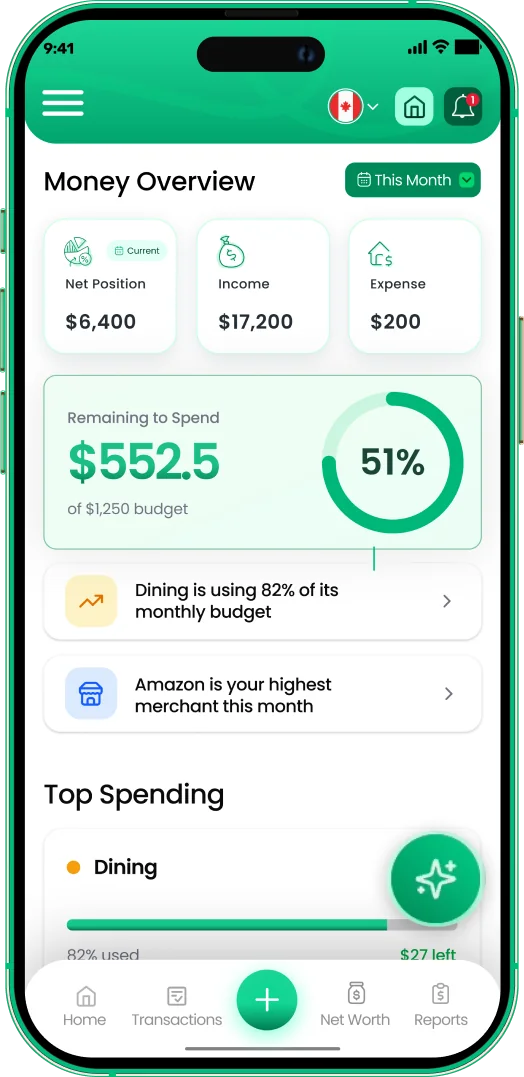

Put the numbers on autopilot
EMOH Pay tracks your spending, budgets and net worth on your phone and in the browser, always in sync. Free to start, made in Canada.
Get started free➜Capital Gains Tax in Canada: frequently asked questions
What is the capital gains tax rate in Canada?
There is no single rate. Half of the gain is added to your income and taxed at your marginal rate, so the effective rate ranges from under 10% to about 27% depending on your income and province.
Did the capital gains inclusion rate change in 2025?
No. The proposed increase to two-thirds on gains above $250,000 was cancelled in March 2025. The inclusion rate remains 50%.
Do I pay capital gains tax when I sell my house?
Usually not, if it was your principal residence for every year you owned it. You must still report the sale and designate the property on your return.
Do I pay capital gains tax on crypto in Canada?
Selling, trading or spending cryptocurrency can create a capital gain or loss, calculated the same way as for shares. Frequent trading may instead be treated as business income.
When do I pay capital gains tax?
You report gains on the return for the year you sold, due 30 April of the following year. Large gains can also make you subject to quarterly instalments the next year.
Related guides and tools
Tax brackets Canada 2026: federal rates from 14% to 33%, every provincial bracket, how marginal tax works and worked…
Tax Filing Deadline Canada 2026Tax deadline Canada 2026: 30 April for most people, 15 June for the self-employed. See every filing, payment and instalment…
TFSA Contribution Limit 2026The TFSA limit for 2026 is $7,000, bringing total room to $109,000 for anyone eligible since 2009. See every year's limit…
What Is a TFSA?What is a TFSA? A plain-language definition of Canada's Tax-Free Savings Account: how it works, what you can hold…
CRA Tax Instalments in CanadaCRA tax instalments explained: the $3,000 rule, the four 2026 due dates, the three ways to calculate payments and how to…
Net Worth CalculatorNet worth is everything you own minus everything you owe. Enter your assets and debts for your number — then track it…
Start free today
Free on iPhone, Android and the web. Upgrade to EMOH Pro anytime for bank sync and advanced AI.
Download for iOS➜ Get it on Android➜