
How to Budget on an Irregular Income
Freelance, commission, gig or seasonal pay does not have to mean a chaotic month. Budget from your lowest month, pay yourself a salary and let the good months fill a buffer.
Get started free➜ Download the app➜
How do I budget when my income changes?
When your income changes, budget from your lowest typical month rather than your average. Deposit all income into a separate holding account, set aside tax, then pay yourself the same fixed amount each month. Good months build a buffer that covers slow ones, and anything above the buffer goes to savings or debt.
Why budgeting with irregular income is different
A standard budget assumes the same paycheque every two weeks. Learning how to budget with irregular income means planning for months that could be half or double your average. Freelancers, contractors, commission sales staff, gig workers, tradespeople and seasonal workers all face the same problem: bills are regular, income is not.
The risk is budgeting from a good month and falling short in a slow one. The solution is to separate when money arrives from when you spend it. A holding account smooths the peaks and dips, so your personal budget runs on a steady, predictable amount.
How to budget with irregular income in 7 steps
- Gather 12 months of income. Use bank deposits or invoices to list what you earned each month.
- Find your baseline. Your lowest typical month, ignoring a true one-off, is the amount you can count on.
- List your bare-bones expenses. Rent, utilities, groceries, insurance, transport, phone and minimum debt payments. If these are above your baseline, this is the first gap to close.
- Open a holding account. Every payment from clients or employers goes here first, never straight to chequing.
- Set tax aside. If no tax is withheld from your income, move a fixed share of each deposit to a separate tax savings account right away.
- Pay yourself a salary. On the same date each month, transfer a fixed amount from the holding account to chequing. Start at your baseline.
- Build the buffer, then sweep the surplus. Once the holding account holds one to three months of your salary, send anything extra to savings goals or debt.
An example of budgeting with irregular income
Here is how to budget with irregular income in practice. A freelance designer earns between $2,600 and $6,400 a month after setting tax aside, an average of about $4,430. She starts with a one-month buffer of $4,000 and pays herself a salary of $3,800 on the first of each month.
| Month | Income deposited | Salary paid to self | Holding account balance |
|---|---|---|---|
| Start | $4,000 | ||
| January | $3,200 | $3,800 | $3,400 |
| February | $5,800 | $3,800 | $5,400 |
| March | $4,100 | $3,800 | $5,700 |
| April | $2,600 | $3,800 | $4,500 |
| May | $6,400 | $3,800 | $7,100 |
| June | $4,500 | $3,800 | $7,800 |
Even in April, her worst month, her personal budget did not change. By June the holding account has $3,800 more than her buffer target, which she can move to an RRSP, a TFSA or extra debt payments. Because her salary sits below her average income, the buffer tends to grow over time.
Budgets that update themselves
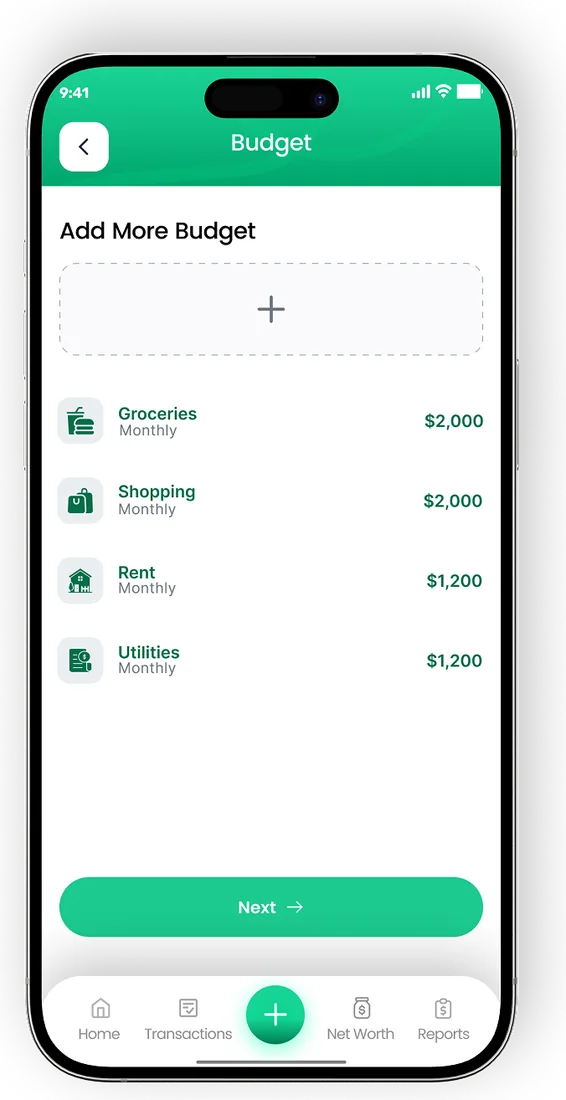
- Set monthly limits for every category
- See what is left to spend in real time
- Get a nudge before a category runs out


How much tax should self-employed Canadians set aside?
There is no single percentage, because it depends on your province, your net income after business expenses and your deductions. Self-employed Canadians also pay both the employee and employer shares of CPP contributions. Estimate your likely tax bill with the income tax calculator, divide it by your expected income and use that share for every deposit.
If your net tax owing is more than $3,000 in the current year and in either of the two previous years ($1,800 in Quebec), the CRA expects quarterly instalments. Our guide to tax instalments in Canada explains the dates. If your self-employed revenue passes $30,000 over four consecutive calendar quarters, you generally need to register for GST/HST; see the small supplier threshold. The page on self-employed taxes in Canada covers the rest.
Which budgeting method works best with irregular income?
Zero-based budgeting works especially well with irregular income, because you assign only the money you actually have rather than money you expect. Percentage methods also work if you apply them to each deposit as it arrives. The main thing to avoid is a budget built around a fixed income you do not yet have.
| Method | How to adapt it | Good for |
|---|---|---|
| Salary from a holding account | Pay yourself a fixed monthly amount | Anyone who wants a stable personal budget |
| Zero-based budgeting | Budget only money already received | Detail-minded freelancers |
| Pay yourself first | Save a percentage of each deposit | People who dislike tracking |
| Priority list | Rank expenses and fund them in order as money arrives | Very uneven or seasonal income |
Read more about zero-based budgeting and pay yourself first, or compare every approach in our budgeting methods guide.
Building an emergency fund on variable pay
Your holding account buffer handles normal dips. An emergency fund handles bigger shocks, such as losing a major client, an injury or equipment failure. People with irregular income often aim for more than the common three-month guideline, because slow periods can last longer and self-employed people usually cannot claim regular EI benefits.
Use the emergency fund calculator to set a target, and build it from the surplus you sweep out of the holding account in good months.
Tracking irregular income without a spreadsheet
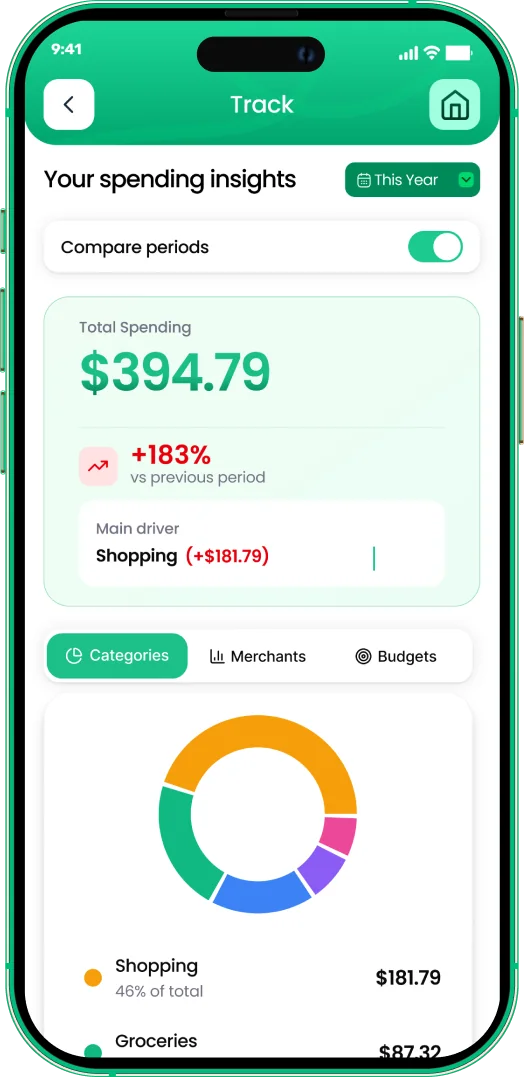
The system works best when you can see income, the buffer and your personal spending in one place. EMOH Pay lets you record income from several clients, track business expenses and GST/HST separately, and set savings goals for your tax account and buffer. On EMOH Pro, bank sync with Canadian banks brings in deposits automatically. The freelancer budgeting app page explains the setup in more detail.
Plan your month in EMOH Pay

Put the numbers on autopilot
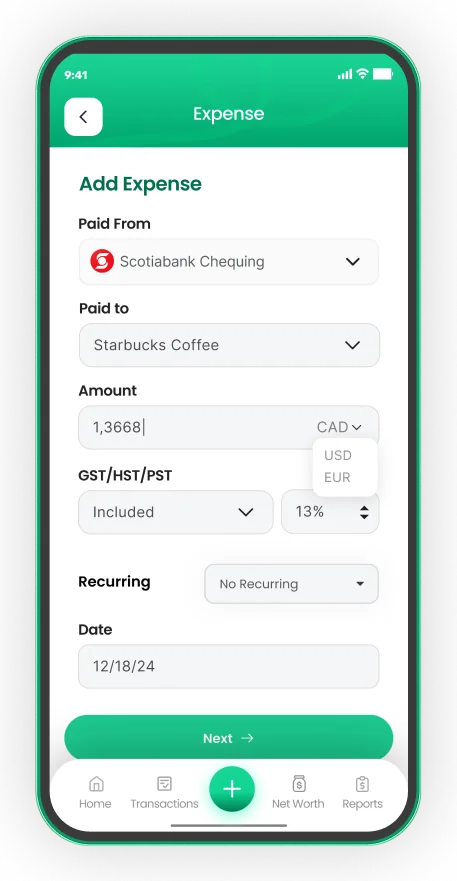
EMOH Pay tracks your spending, budgets and net worth on your phone and in the browser, always in sync. Free to start, made in Canada.
Get started free➜How to Budget on an Irregular Income: frequently asked questions
Should I budget from my average or my lowest month?
Budget from your lowest typical month. Budgeting from your average means you fall short about half the time, while budgeting from the low leaves room for good months to build your buffer.
How big should my buffer be?
Aim for one to three months of your personal salary in the holding account, plus a separate emergency fund. The more uneven your income, the larger the buffer should be.
What if my lowest month does not cover my essentials?
Close the gap first. Cut fixed costs where you can, raise rates, add a steadier income stream or build the buffer before you commit to new expenses.
Do I need a separate business bank account?
It is not always required for sole proprietors, but a separate account makes it much easier to track income, expenses and tax. It can double as your holding account.
How often should I review my salary amount?
Review it every three to six months. If the holding account keeps growing past your buffer, raise your salary a little. If it keeps shrinking, lower it.
Related guides and tools
50/30/20, zero-based, envelopes or pay-yourself-first — the best budgeting method is the one you'll still be using in March.…
Built for irregular incomeEMOH Pay tracks freelance income, separates GST/HST for tax time, and smooths irregular months into a budget you can…
CRA Tax Instalments in CanadaCRA tax instalments explained: the $3,000 rule, the four 2026 due dates, the three ways to calculate payments and how to…
Self-Employed Taxes in CanadaSelf employed taxes in Canada explained: income tax, both halves of CPP, GST/HST and instalments, with a worked 2026 example…
Emergency Fund Calculator — Free CalculatorYour emergency fund target is 3–6 months of essential expenses. Enter monthly essentials below for your range. Free…
Pay Yourself FirstPay yourself first means saving before you spend. See what it means, a pay yourself first example on a Canadian paycheque…
Start free today
Free on iPhone, Android and the web. Upgrade to EMOH Pro anytime for bank sync and advanced AI.
Download for iOS➜ Get it on Android➜