
30-Day Savings Challenge
Save $1 on day 1, $2 on day 2 and keep going to $30 on day 30. You finish the month with $465, and the tracker below lets you scale it up or down.
Use the calculator➜ Try EMOH Pay free➜
How does the 30-Day Savings Challenge work?
The 30-day savings challenge works by saving a little more each day for a month: $1 on day 1, $2 on day 2, and so on up to $30 on day 30. Added together, the classic version saves $465. You can halve it to $232.50, double it to $930 or reverse the order so the biggest days come first.
How the 30-day savings challenge works
The 30-day savings challenge is a one-month sprint. Each day you move a slightly bigger amount into savings, starting at $1 and rising by $1 a day. Because the amounts climb slowly, the first week feels almost effortless, which helps build the habit before the bigger days arrive.
The tracker above calculates everything for you. Enter a multiplier of 1 for the classic version, then try 0.5, 2 or 5 to see a version that fits your budget. The table shows each day's deposit and your running total.
- Pick a start date, ideally a payday or the first of the month.
- Decide where the money goes: a separate savings account keeps it out of daily spending.
- Each day, transfer that day's amount: $1 on day 1, $2 on day 2, up to $30.
- Cross off the day on a printed chart or mark it in your app.
- On day 30, check your total and decide what the money is for.
30-day savings challenge chart
Here is how the classic version builds through the month. Half the total arrives in the final nine days, so plan your cash flow for the last week.
| Day | Deposit that day | Running total |
|---|---|---|
| Day 1 | $1 | $1 |
| Day 7 | $7 | $28 |
| Day 10 | $10 | $55 |
| Day 14 | $14 | $105 |
| Day 21 | $21 | $231 |
| Day 25 | $25 | $325 |
| Day 30 | $30 | $465 |
Week 1 adds $28. Week 4 alone, days 22 to 28, adds $175. That jump is the main reason people stall, so it helps to line the final week up with a payday.
30-day savings challenge printable layout
A printable version is simply a grid of 30 boxes, numbered 1 to 30, each with its dollar amount. Five rows of six boxes fit neatly on one page. Colour in or cross off each box as you save.
If you prefer not to print, the same idea works in a notes app or in EMOH Pay. Create a savings goal of $465, log each day's deposit, and the progress bar fills as you go.
- Row 1: days 1 to 6, $1 to $6, subtotal $21
- Row 2: days 7 to 12, $7 to $12, subtotal $57
- Row 3: days 13 to 18, $13 to $18, subtotal $93
- Row 4: days 19 to 24, $19 to $24, subtotal $129
- Row 5: days 25 to 30, $25 to $30, subtotal $165
Tips that help you save
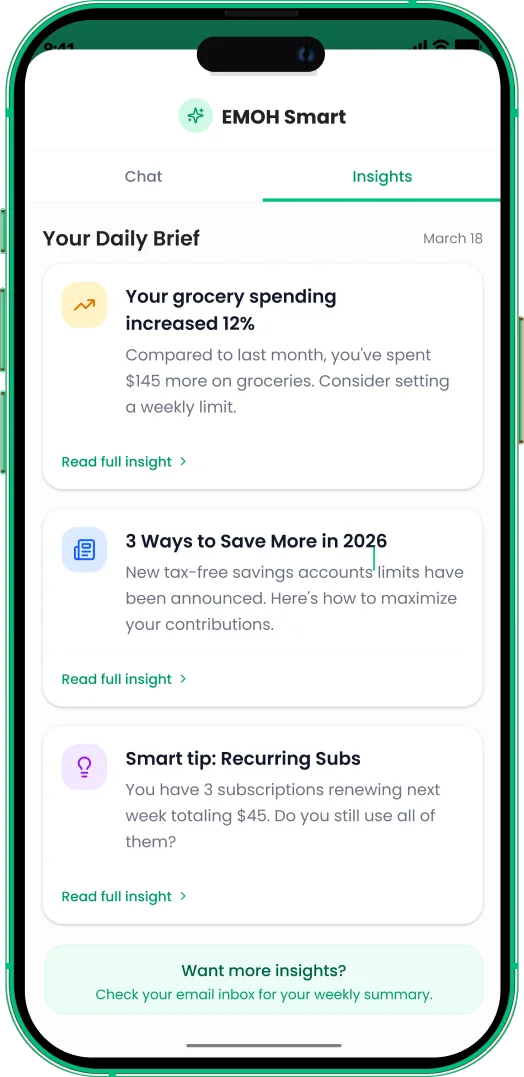
- A daily brief with practical ways to save
- Spot recurring subscriptions worth cutting
- Watch your savings show up in your net worth


Which version of the 30-day challenge fits your budget?
Choose the version whose biggest day you can cover without dipping into bill money. For the classic version that is $30 on day 30. If that is a stretch, start smaller. Finishing matters more than the total.
| Version | Day 1 | Day 30 | Total |
|---|---|---|---|
| Half | $0.50 | $15 | $232.50 |
| Classic | $1 | $30 | $465 |
| Double | $2 | $60 | $930 |
| Five times | $5 | $150 | $2,325 |
| Flat $5 a day | $5 | $5 | $150 |
| Flat $10 a day | $10 | $10 | $300 |
A reverse version starts at $30 and counts down to $1. The total is the same $465, but the hardest days come while motivation is high. It works well if you start right after payday.
Ways to find the extra money
The average day in the classic challenge is $15.50. Most people cover that by trimming a few small daily costs rather than one big change.
- Pair it with a spending pause. A month without takeout or online shopping frees up cash. Our no-buy challenge guide shows how to set rules.
- Check subscriptions. Cancelling one or two unused services can cover several days.
- Sell something. Listing a few unused items can fund the final week.
- Use found money. Cash back, a small refund or a gift can go straight into the challenge.
- Look at your budget. A quick review using the budget calculator can show where a daily $15 could come from.
What to do after the 30 days
One month is a great test of whether a savings challenge suits you. If you finished, you have $465 and a daily habit. The next step is to make it longer or automatic.
Many people move on to the 52-week money challenge, which saves $1,378 over a year at a gentler weekly pace, or the 365-day savings challenge, which uses tiny daily deposits. Compare every option in our list of savings challenge ideas.
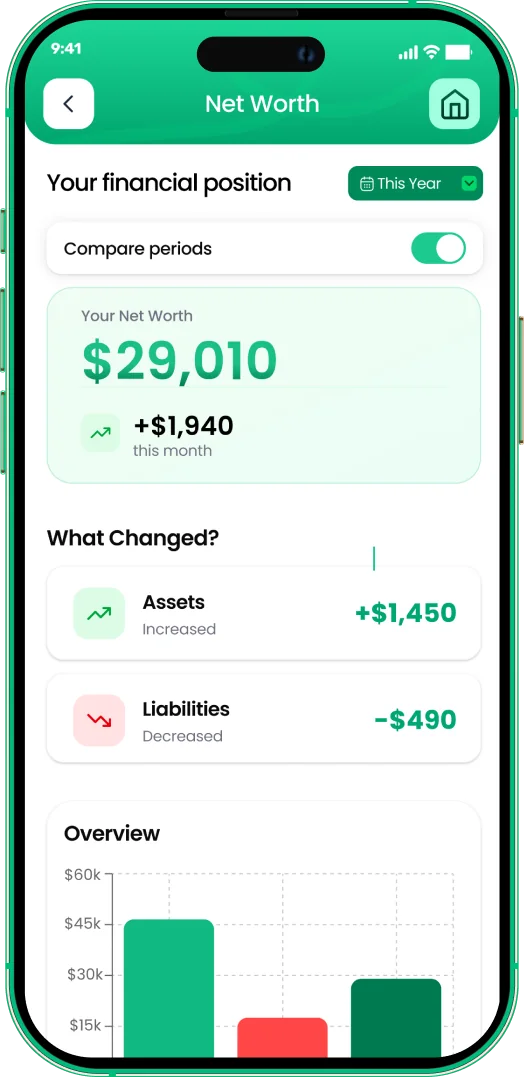
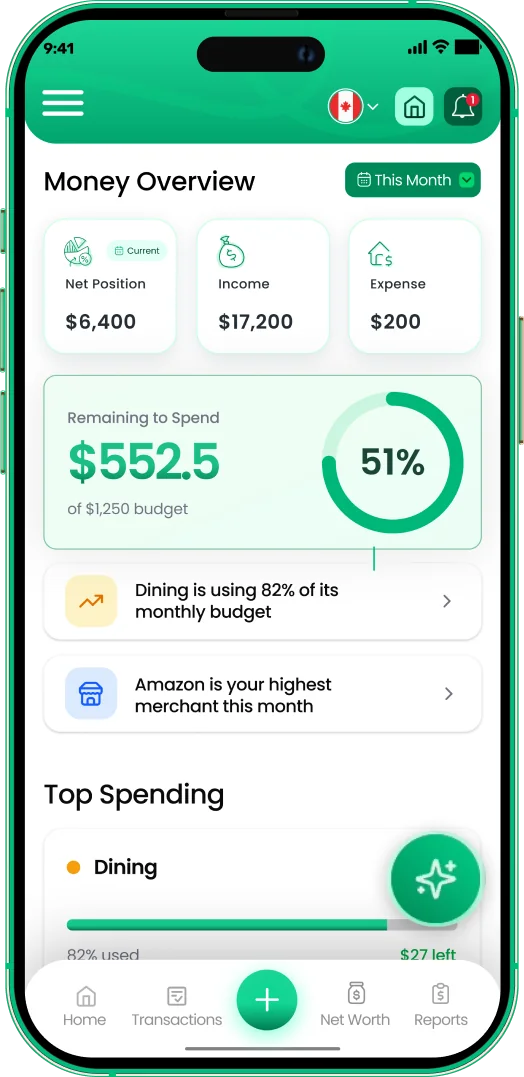
To keep saving without thinking about it, set up an automatic transfer on payday for about the same amount you saved this month. EMOH Pay can track it as a savings goal next to your budgets, bills and net worth, on iPhone, Android and the web. See the full list of features.
Save more with EMOH Pay

Put the numbers on autopilot
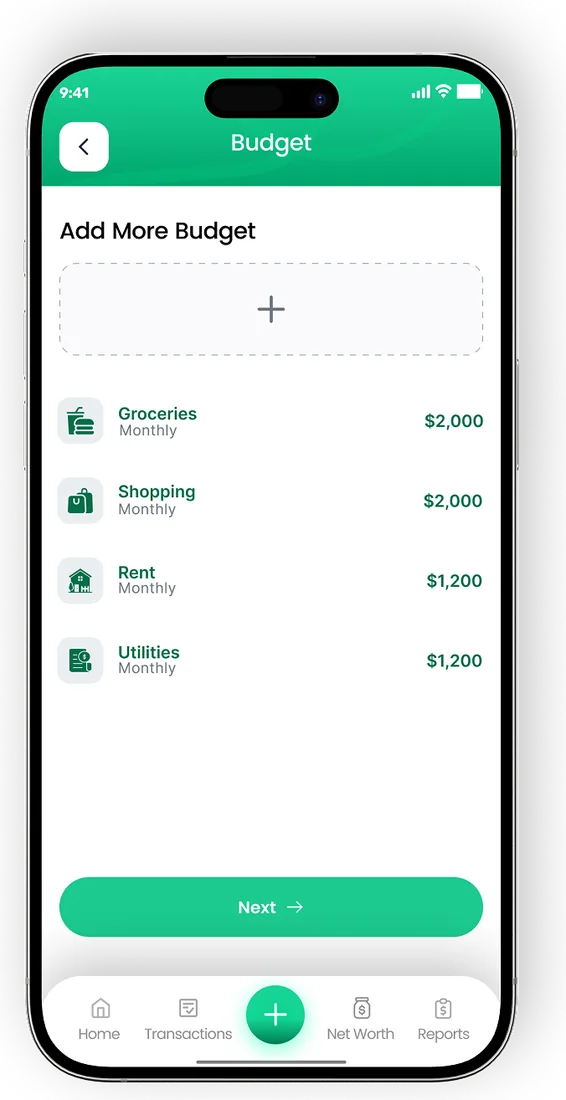
EMOH Pay tracks your spending, budgets and net worth on your phone and in the browser, always in sync. Free to start, made in Canada.
Get started free➜30-Day Savings Challenge: frequently asked questions
How much do you save in the 30-day savings challenge?
The classic version saves $465. That is the sum of $1 through $30. A half version saves $232.50 and a double version saves $930.
Can I start the 30-day challenge in the middle of the month?
Yes. Any 30 consecutive days work. Starting on a payday can help, because the money for the first stretch is already there.
What if I miss a day?
Add the missed amount to the next day or extend the challenge by a day. The total stays the same as long as every number gets saved.
Should I use cash or a bank account?
Either works. A separate savings account is safer and keeps the money out of reach of everyday spending. Cash in a jar is more visible but easier to dip into.
Is the 30-day challenge the same as a no spend month?
No. The 30-day savings challenge sets aside a rising amount each day. A no spend month cuts non-essential spending to zero. You can do both at once, and the no spend month often funds the savings challenge.
Sources and further reading
Related guides and tools
Ten savings challenge ideas compared by total saved, length and difficulty, from the 52-week and 100 envelope challenges to…
52-Week Money Challenge (Free Tracker)The 52 week money challenge saves $1,378 in a year by adding $1 more each week. Use the free tracker to scale it, see every…
365-Day Savings ChallengeThe 365 day savings challenge saves $667.95 by adding one cent a day for a year. Use the free tracker, compare versions and…
100 Envelope ChallengeThe 100 envelope challenge saves $5,050 in 100 days. Use the free tracker and chart, pick a smaller or faster version, and…
No-Buy Challenge: How to Do ItA no-buy challenge means buying only essentials for a set time. Learn how to set rules, build a need list, try a low buy…
Savings Goal Calculator — Free CalculatorHow much to save per month? Enter your target amount and months until deadline — get your required monthly contribution…
Start free today
Free on iPhone, Android and the web. Upgrade to EMOH Pro anytime for bank sync and advanced AI.
Download for iOS➜ Get it on Android➜