
Ontario Take-Home Pay Calculator
Enter your salary to see what an Ontario employer actually deposits. The calculator splits out federal tax, Ontario tax, CPP and EI, then shows your pay per month, pay period or year.
Use the calculator➜ Try EMOH Pay free➜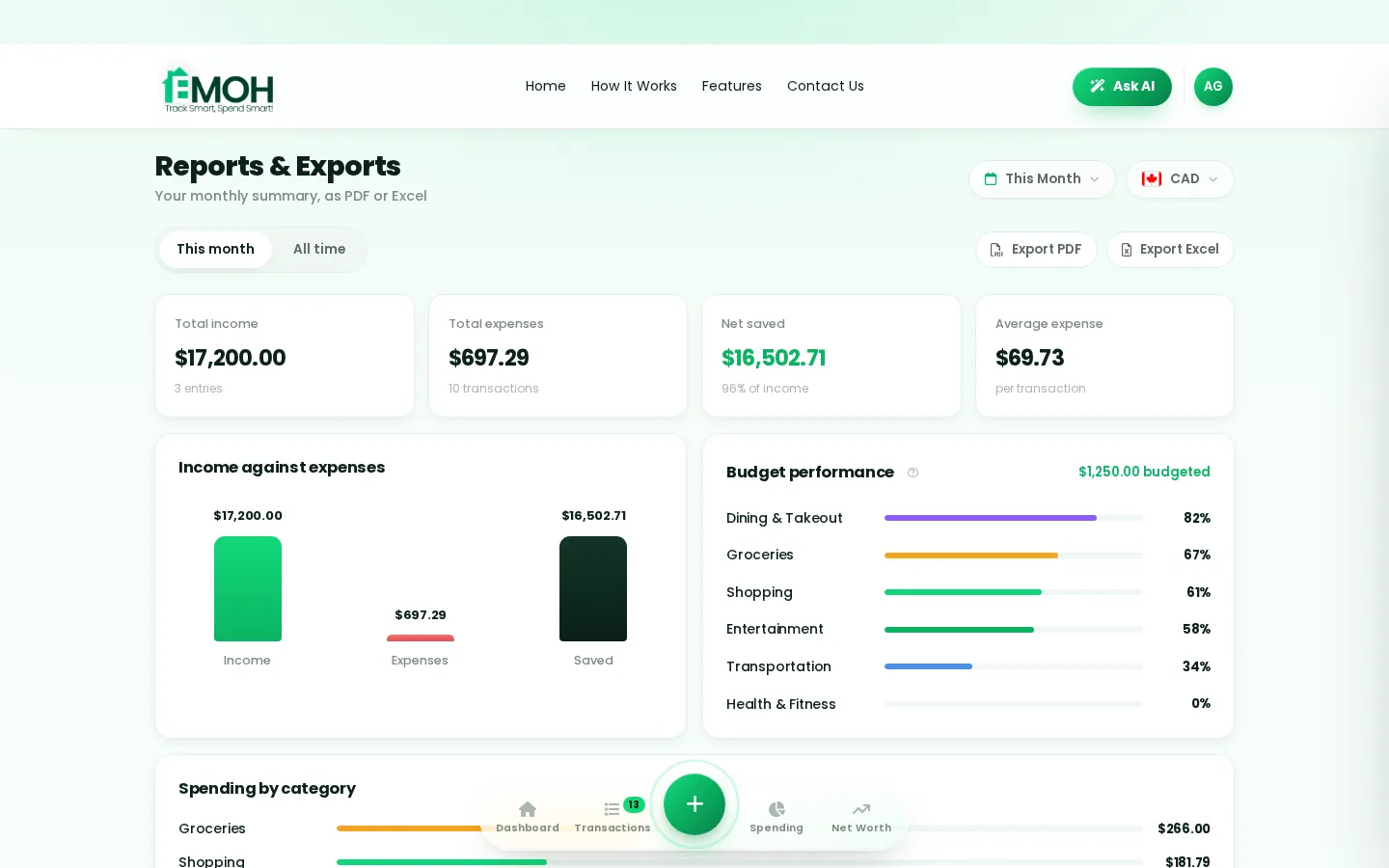

What is my take-home pay in Ontario?
On a $75,000 salary in Ontario in 2026 you take home about $57,400 a year, or roughly $4,780 a month, after federal tax, Ontario tax, CPP and EI. That is an average deduction rate of about 23.5%. At $50,000 you keep about $40,500, and at $100,000 about $74,500, before the Ontario Health Premium.
2026 rates for a resident employee with the basic personal amount only. Verify against the CRA and provincial tables each January.
How the Ontario salary calculator works
This Ontario salary calculator asks for three things. Annual gross salary is your pay before any deductions. RRSP contributions this year is optional; anything you enter is subtracted from taxable income, the way the CRA treats it at filing time. Show take-home pay per lets you view the result monthly, semi-monthly, bi-weekly, weekly or annually.
Behind the scenes it applies the 2026 federal brackets and Ontario's five provincial brackets, subtracts the federal and Ontario basic personal amounts as credits, adds Ontario's surtax where it applies, and deducts CPP and EI. The result shows each deduction, your average tax rate and your marginal rate on the next dollar.
It assumes you are an Ontario resident employee with no other credits. It does not add the Ontario Health Premium, which is collected through payroll, so subtract that separately using the table further down.
Ontario tax brackets for 2026
Ontario has five brackets. The two lowest thresholds are indexed to inflation each January; the $150,000 and $220,000 thresholds are fixed in law. The figures below are the 2025 thresholds indexed for 2026, so treat them as close estimates until you check the Ontario government's published table.
| Taxable income | Ontario rate |
|---|---|
| Up to about $53,900 | 5.05% |
| About $53,900 to $107,900 | 9.15% |
| About $107,900 to $150,000 | 11.16% |
| $150,000 to $220,000 | 12.16% |
| Over $220,000 | 13.16% |
Federal tax is added on top. The federal rate starts at 14% on the first $58,523 in 2026, so an Ontarian earning $75,000 faces a combined marginal rate of about 29.65% on each extra dollar. For the full federal picture, see our 2026 Canadian tax brackets guide or the dedicated Ontario tax brackets page.
What makes Ontario different: the surtax and the Health Premium
Two Ontario features catch people out. Neither exists in most other provinces.
The Ontario surtax
Once your basic Ontario tax passes about $5,800, you pay an extra 20% on the amount above that line, and a further 36% once it passes about $7,500. In practice the surtax starts to bite at incomes of roughly $95,000 to $100,000 and is why Ontario's top combined rate reaches 53.53%. The calculator includes it.
The Ontario Health Premium
Ontario residents with taxable income over $20,000 pay a Health Premium on their tax return, and employers deduct it from pay. It is $0 up to $20,000, rises to $300 at about $25,000, $450 at about $38,500, $600 at about $48,600, $750 at about $72,600 and caps at $900 above about $200,600. A $75,000 earner pays $750 a year, or $62.50 a month.
Low-income relief
The Ontario tax reduction and the LIFT credit (Low-income Individuals and Families Tax credit) can reduce or eliminate Ontario tax for lower earners. They are claimed on your return, so the calculator may overstate tax for incomes under about $50,000.

Track every paycheque
- Add each income source in seconds
- See income against spending every month
- Plan from your real take-home pay


Take-home pay in Ontario at common salaries
These results come straight from the calculator for a single employee with no RRSP contribution. Subtract the Health Premium shown to get the amount most likely to land in your account.
| Gross salary | Income tax (fed + ON) | CPP + EI | Annual take-home | Monthly | Health Premium |
|---|---|---|---|---|---|
| $40,000 | $4,122 | $2,824 | $33,054 | $2,755 | $450 |
| $50,000 | $5,883 | $3,582 | $40,535 | $3,378 | $600 |
| $60,000 | $7,988 | $4,340 | $47,673 | $3,973 | $600 |
| $75,000 | $12,242 | $5,369 | $57,388 | $4,782 | $750 |
| $100,000 | $19,692 | $5,769 | $74,538 | $6,212 | $750 |
| $150,000 | $39,693 | $5,769 | $104,538 | $8,711 | $750 |
Notice how CPP and EI stop growing after about $85,000. Above that line every extra dollar is taxed only by income tax, which is why take-home pay rises steadily even as the marginal rate climbs.
Worked example: $75,000 salary in Toronto
If the same person puts $5,000 into an RRSP, the calculator shows deductions falling to about $16,129 and take-home rising to about $58,871 once the refund is counted. That is roughly $1,480 back for a $5,000 contribution.
- Federal tax. Tax on $75,000 through the federal brackets, minus the 14% credit on the basic personal amount, CPP and EI, comes to about $8,518.
- Ontario tax. Ontario's brackets give about $3,724 after its own credits. Basic Ontario tax is below the surtax line, so no surtax applies.
- CPP. 5.95% of earnings between $3,500 and $74,600, plus 4% on the $400 above that, is about $4,246.
- EI. 1.63% of insurable earnings up to $68,900 is about $1,123.
- Result. $75,000 minus $17,612 in deductions leaves about $57,388 a year, $4,782 a month or $2,207 every two weeks. Take off the $750 Health Premium and you are near $56,640.
How Ontario compares with other provinces
On a $75,000 salary Ontario sits near the top for take-home pay, thanks to its low 5.05% starting rate. The surtax only matters at higher incomes, where Ontario becomes more expensive than Alberta or BC.
To compare the rest of the country, try the Canadian income tax calculator or the Alberta salary calculator.
Once you know your net pay, the next step is deciding where it goes. Plug the monthly figure into our 50/30/20 budget calculator, then track real spending against it in EMOH Pay, which is free on iPhone, Android and the web. Our guide to budgeting in Ontario covers rent, transit and hydro costs across the province.
Figures checked September 2026 using 2026 federal rates and Ontario thresholds indexed from 2025. Confirm current numbers with the CRA and the Government of Ontario.
Your income in EMOH Pay
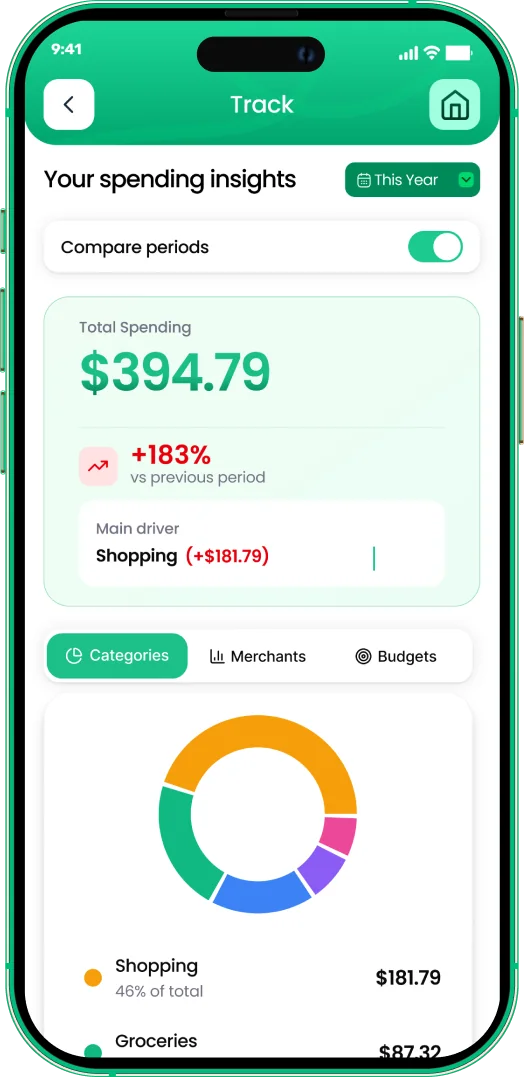
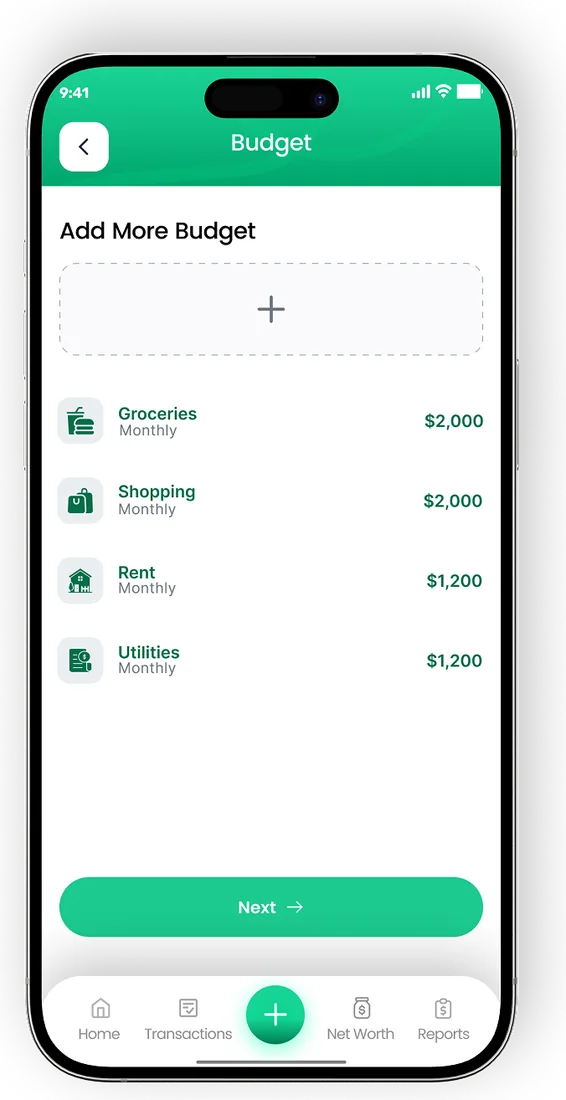
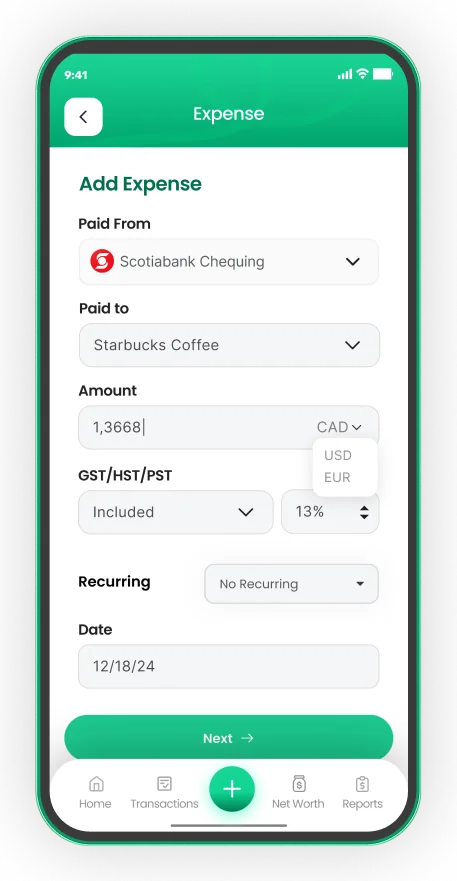

Put the numbers on autopilot
EMOH Pay tracks your spending, budgets and net worth on your phone and in the browser, always in sync. Free to start, made in Canada.
Get started free➜Ontario Take-Home Pay Calculator: frequently asked questions
How much is taken off a paycheque in Ontario?
For most salaried Ontarians, between about 17% and 30% of gross pay goes to federal tax, Ontario tax, CPP and EI. At $75,000 it is about 23.5%, plus the Ontario Health Premium of $750 a year.
Is the Ontario Health Premium included in the calculator?
No. The calculator covers income tax, the Ontario surtax, CPP and EI. Subtract the Health Premium, which ranges from $0 to $900 a year depending on taxable income, to match your pay stub.
What is the Ontario basic personal amount for 2026?
It was $12,747 in 2025 and is indexed each year, so it is about $13,000 for 2026. It is claimed as a credit at 5.05%, which is worth roughly $650 off your Ontario tax.
At what income does the Ontario surtax start?
The surtax applies when basic Ontario tax, not income, passes about $5,800. For a typical employee that happens at taxable income of roughly $95,000 to $100,000.
Why is my bi-weekly pay different from the calculator?
Employers use CRA payroll formulas that spread CPP and EI evenly until you hit the annual maximums, and they may include benefits, pension deductions or a TD1 claim above the basic amount. The annual totals should end up close.
Sources and further reading
Related guides and tools
Estimate your 2026 Canadian income tax, CPP, EI and take-home pay in every province and territory, with federal and…
Ontario Tax Brackets 2026Ontario tax brackets 2026 run from 5.05% to 13.16%. See every threshold, how the Ontario surtax and health premium work, and…
Paycheque Calculator CanadaPaycheque calculator for Canada: enter gross pay per cheque, pay frequency and province to see income tax, CPP, EI and your…
50/30/20 Budget CalculatorThe 50/30/20 rule splits after-tax income: 50% to needs, 30% to wants, 20% to savings. Enter your monthly take-home pay to…
Budgeting in OntarioBudgeting in Ontario: sales tax is 13% HST, minimum wage $17.20/hr, typical rent $2,000+/month. Toronto and Ottawa rents are…
RRSP CalculatorFree RRSP calculator for 2026: see the tax refund on your contribution, what it really costs after tax, your new room and…
Start free today
Free on iPhone, Android and the web. Upgrade to EMOH Pro anytime for bank sync and advanced AI.
Download for iOS➜ Get it on Android➜