The Ultimate Guide to Budgeting in 2026: Build a Budget That Actually Sticks

Money stress is one of the most common — and most solvable — problems in modern life. Yet fewer than 30% of people follow a formal budget, even though study after study shows that people who budget save more, carry less debt, and feel significantly less financial anxiety.
This is your complete, no-fluff guide to budgeting in 2026. Whether you’ve never made a budget before, tried and failed with spreadsheets, or just want to modernize your approach with the best tools available today — you’re in the right place.
By the end of this guide, you’ll know exactly which budgeting method suits your life, how to set it up in under 20 minutes, and which app will do the heavy lifting for you.
Want to skip straight to building your budget? Download EMOH Pay free and follow the in-app setup. Most users have their first budget running in under 20 minutes.
What Is Budgeting — And Why Most People Get It Wrong
A budget is simply a plan for your money. It tells every pound, dollar, or euro you earn where to go — before you spend it. That’s it. No complicated spreadsheets required.
Most people who ‘fail’ at budgeting aren’t failing at the maths. They’re using the wrong method for their lifestyle, or they’re relying on willpower alone instead of a system.
The three biggest budgeting mistakes:
- Making the budget too rigid — life changes and your budget must be able to flex with it
- Tracking only some expenses — one missed subscription or cash purchase unravels the whole plan
- Reviewing too infrequently — a budget checked monthly is far less effective than one checked weekly
Related: → How to Track Expenses Automatically (No Spreadsheets)
Step 1: Know Your Numbers — Income & Fixed Expenses
Before you choose a method or open any app, you need two pieces of information: your total monthly take-home income, and your fixed monthly commitments.
Net income is what lands in your account after tax and any automatic deductions. If you’re salaried, check your pay slip. If you’re self-employed or freelance, use a 3-month average as your baseline.
- Salary / wages (after tax)
- Freelance or side income (average last 3 months)
- Rental income, dividends, or other passive income
- Government benefits or child credits
Fixed expenses are bills that are the same (or nearly the same) every month:
- Rent or mortgage
- Loan repayments (car, student, personal)
- Insurance premiums
- Phone, internet, and streaming subscriptions
- Gym memberships
Instead of manually listing every expense, connect your bank account to EMOH Pay via Plaid. It automatically imports your last 90 days of transactions, categorizes them, and shows you exactly where your money has been going. Setup takes under 5 minutes.
See how bank syncing works: → How EMOH Pay Works
Step 2: Choose a Budgeting Method
There is no single ‘best’ budgeting method. The right one is the one you’ll actually use. Here are the four most popular, with honest assessments of who each suits:
Split your after-tax income into three buckets: 50% needs, 30% wants, 20% savings and debt repayment. Simple, flexible, and requires almost no maintenance.
- Best for: People new to budgeting, those with stable income
- Weakness: Too broad for people trying to eliminate debt quickly or save aggressively
Read our deep-dive: → The 50/30/20 Rule: Budget Your Salary Smarter
Every pound of income is assigned a job. Income minus all outgoings — including savings — equals zero. You’re not spending everything; you’re intentionally allocating every dollar.
- Best for: Debt payoff, aggressive savers, people living paycheck-to-paycheck
- Weakness: Time-intensive without the right app
Read our deep-dive: → Zero-Based Budgeting: The Complete Beginner Guide
Cash is divided into labelled envelopes by category. When an envelope is empty, spending in that category stops. In 2026, digital apps replicate this without actual cash.
- Best for: Curbing impulsive spending, grocery and dining budgets
- Weakness: Less practical in a cashless world without a digital app
The moment you’re paid, a set amount is automatically transferred to savings or investments. You budget only with what’s left. Savings become non-negotiable.
- Best for: Long-term wealth building, people who find budgeting tedious
- Weakness: Can mask overspending in day-to-day categories
EMOH Pay supports all four methods above. Here’s how to get your first real budget running in under 20 minutes:
- Download EMOH Pay from the App Store or Google Play
- Create your account — enter your name, email, and set a secure password
- Connect your bank account via Plaid (or enter balances manually if preferred)
- Enter your monthly income when prompted
- Review the auto-imported transactions — confirm or adjust categories
- Set budget limits for each spending category (groceries, utilities, dining, transport, etc.)
- Add your savings goals — emergency fund, holiday, home deposit
- Enable weekly summary notifications so you stay on track
Unlike most budgeting apps, EMOH Pay lets you tag expenses to specific household members — ‘Mum’s grocery run’, ‘Dad’s commute’, ‘Kids’ school supplies. This gives families granular visibility into spending patterns without needing separate accounts.
Explore all features: → EMOH Pay Features
Step 4: Budget Categories You Shouldn’t Miss
Most people set up the obvious categories (rent, food, transport) but forget the ones that silently drain their budget:
Step 5: Review, Adjust, and Stay Consistent
A budget is not a document you set once and forget. It’s a living plan that evolves with your life. Here’s a simple review rhythm:
- Open EMOH Pay and review spending since last check
- Ensure no unrecognized transactions
- Check remaining budget in any categories running low
- Review last month’s totals vs budget in each category
- Identify any consistent overruns and adjust limits realistically
- Check savings goal progress and adjust contributions if needed
- Review net worth dashboard — are assets growing?
- Export full year report from EMOH Pay (PDF or Excel)
- Review tax-relevant expenses using the Tax Summary feature
- Reassess financial goals for the coming year
- Adjust income figures if salary has changed
Generate your monthly report: → EMOH Pay Solutions
Common Budgeting Questions Answered
Q: How much should I save each month?
A commonly cited benchmark is 20% of your take-home income (the 50/30/20 rule). However, the ‘right’ amount depends on your goals and debts. If you have high-interest debt, prioritize paying that off first. If you’re building an emergency fund, aim for 3–6 months of expenses before investing.
Q: What if my income is irregular?
Use a baseline budget built on your lowest expected monthly income from the past 6 months. Anything earned above that baseline gets allocated to savings or debt when it arrives. EMOH Pay’s goal-setting feature is ideal for irregular earners who want to capture income spikes.
Q: Is it worth connecting my bank account to a budgeting app?
Yes — bank syncing removes the biggest barrier to consistent budgeting: manual data entry. EMOH Pay connects via Plaid, which uses bank-level 256-bit encryption. Your credentials are never stored in the app.
Q: How is EMOH Pay different from a spreadsheet?
A spreadsheet requires manual entry, is prone to formula errors, and gives you no alerts when you’re overspending. EMOH Pay imports transactions automatically, categorizes them, sends alerts, tracks net worth, supports multiple currencies, and generates tax summaries — all for free.
Download EMOH Pay Free — Available on iOS & Android
App Store: apps.apple.com/pk/app/emoh/id6743326641
Google Play: play.google.com/store/apps/details?id=com.buildmeapp.emoh
Related Guides from EMOH Pay
→ Best Budgeting Apps 2026: Tested & Ranked
→ How to Track Expenses Automatically
→ How Couples Can Manage Money Together
→ EMOH Pay vs YNAB vs Mint: Full Comparison
→ Zero-Based Budgeting: The Complete Beginner Guide
Try the free budget calculator
Reading is step one — EMOH Pay makes it automatic. Free to start on phone and web.
Open it➜What should you know about budgeting in 2026?
Budgeting in 2026 comes down to three habits: know what comes in, decide where it goes, and check in daily. EMOH Pay makes all three effortless — free expense tracking and budgets on phone and web, a Daily Money Digest each morning, and bank-grade AES-256 security throughout.
Budgeting in 2026: the essentials
Money works better as a team sport — shared live numbers end the guesswork and the arguments.
The first win in budgeting in 2026 is simply seeing where money goes. Tracking alone typically surfaces 10–15% of easy savings.
You can start budgeting in 2026 today at $0 — no card required, on iPhone, Android or the web.
Five minutes a week with a daily digest beats a perfect spreadsheet you abandon in February.
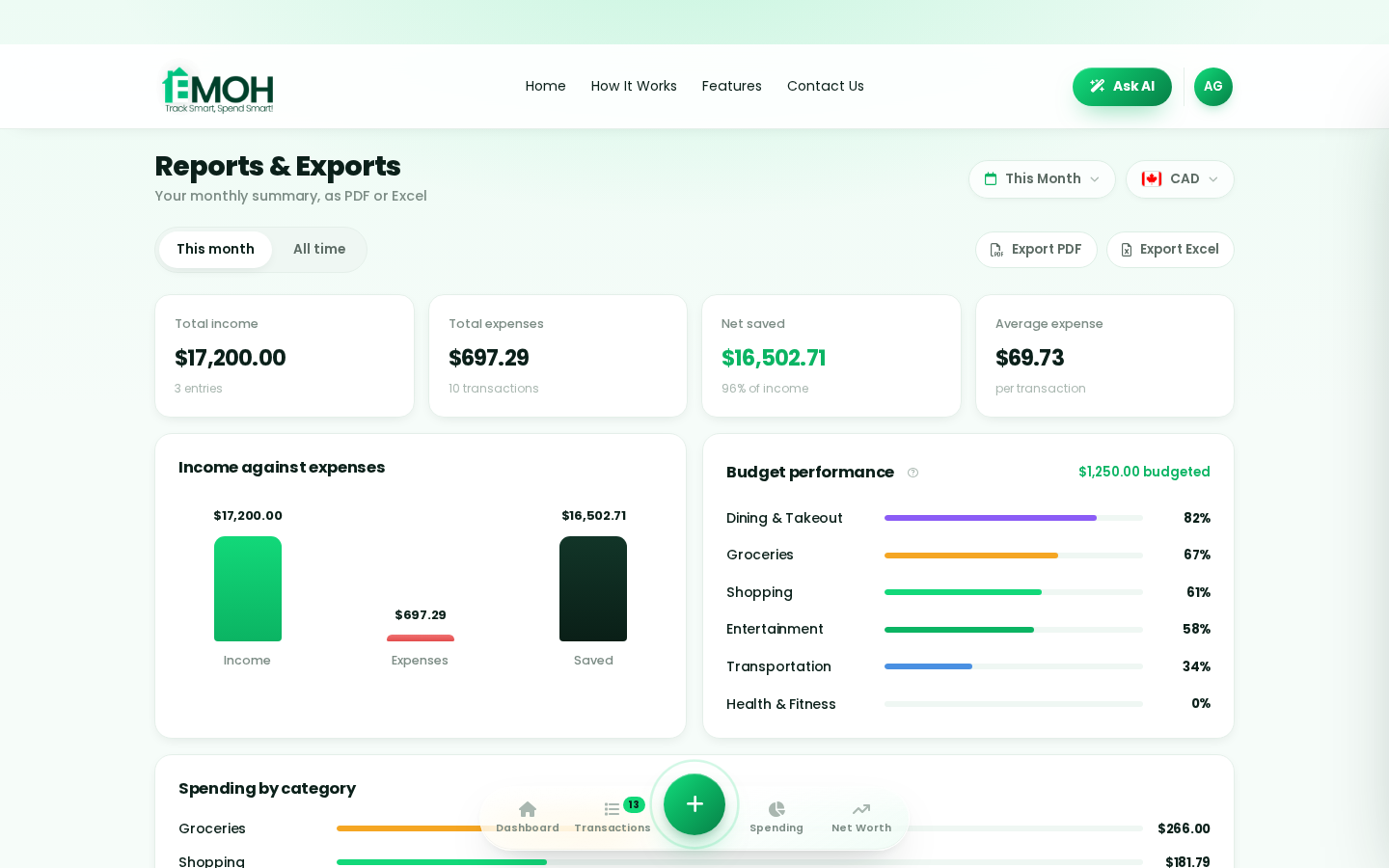
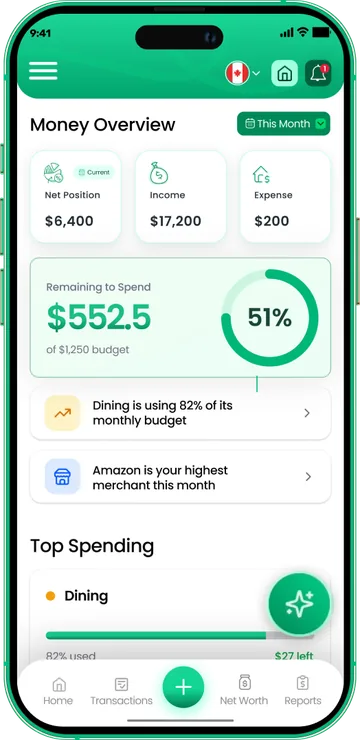
One app for budgeting in 2026 — on every screen.
Track on your phone in the checkout line, review on the web app at your desk. EMOH Pay keeps budgeting in 2026 in sync the second anything changes, so the numbers you act on are always current.
Start free on the web➜ Explore all features➜Real spending, really tracked
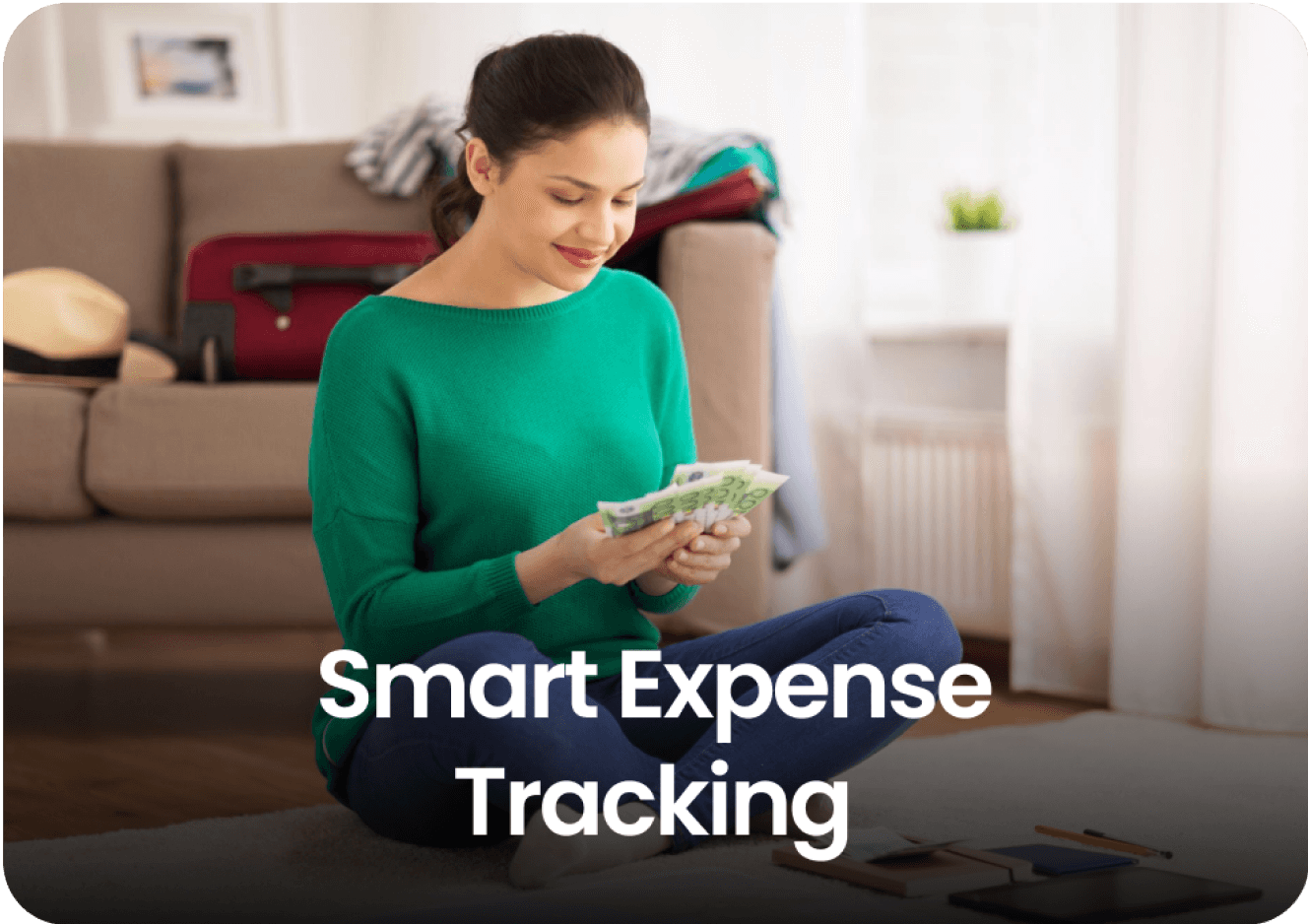
From the morning coffee to the monthly rent — Canadians log, tag and learn from every expense on EMOH Pay.


Everything you need for budgeting in 2026
Track Smart, Spend Smart! The complete toolkit, free to start:
Log any expense in two taps — or let bank sync do it automatically. Every dollar gets a category.
Assets minus debts, always current — watch the number that actually measures progress.
Digital envelopes for groceries, rent and fun, with gentle alerts before you overspend.
Automatic conversion for money that lives in more than one country.
Turn any month into a clean report you can share with a partner or accountant.
One calm summary every morning: what you spent, what's left, what needs attention.
How to start budgeting in 2026 with EMOH Pay
Four small steps, five minutes total:
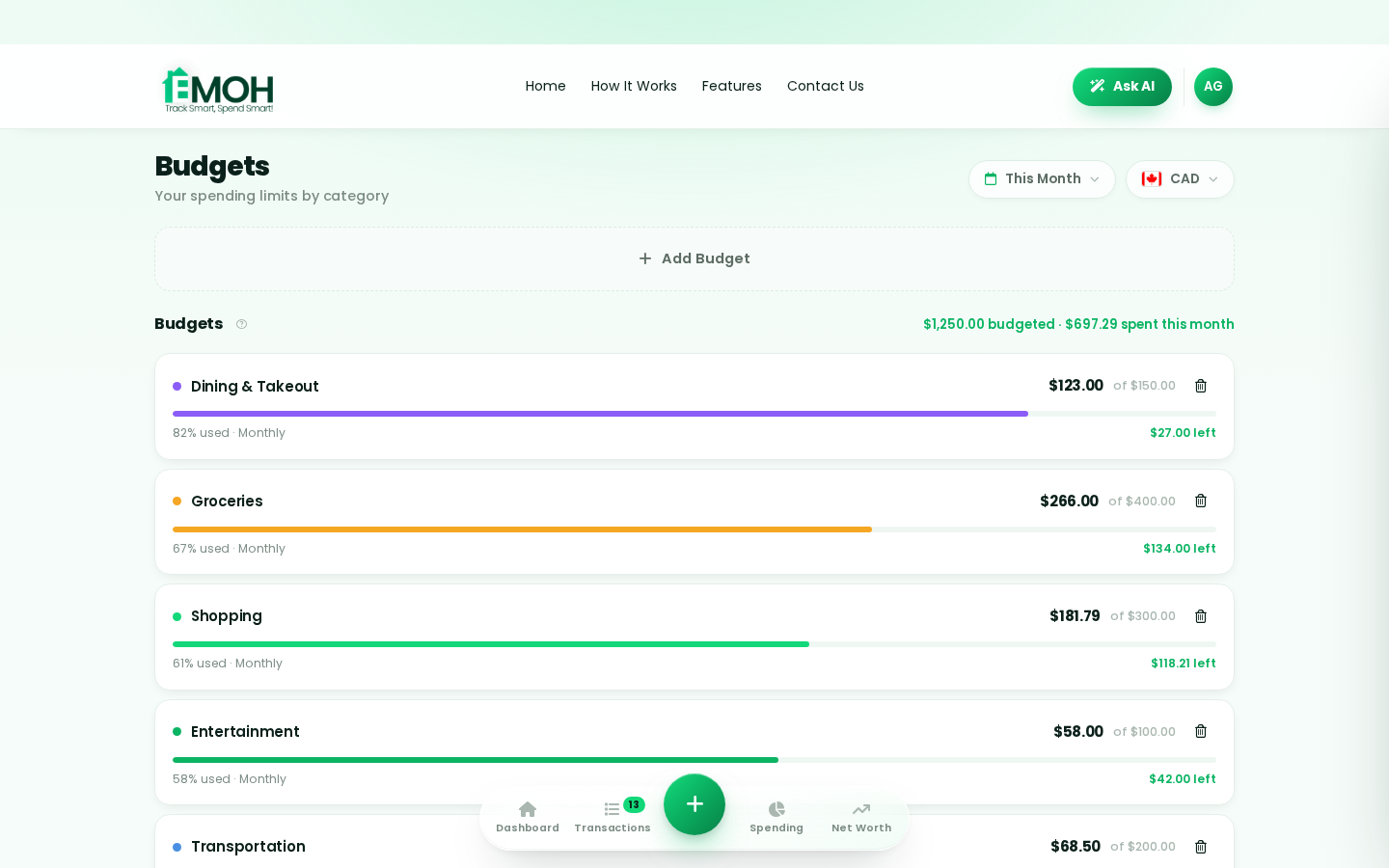
EMOH Pay vs. the usual ways to handle budgeting in 2026
| EMOH Pay | Spreadsheet | Typical budgeting app | |
|---|---|---|---|
| Free tier | Free forever | Free | Limited trial |
| Paid tier | EMOH Pro — $4.99/mo | — | $10–15/mo |
| Expense tracking | ✔ Two taps or automatic | Manual entry | ✔ |
| Budgets & overspend alerts | ✔ Built in | ✖ None | Varies |
| Net worth tracking | ✔ Live | Formula gymnastics | Often paid add-on |
| Phone + web sync | ✔ Instant | ✖ Manual | Varies |
| Family sharing | ✔ Free | ✖ Shared-file chaos | Often paid add-on |
| GST/HST tracking | ✔ Automatic | ✖ Formula gymnastics | ✖ Rare |
| 148 currencies | ✔ Automatic conversion | ✖ None | Limited |
| Ask AI | ✔ Included | ✖ None | ✖ Rare |
| Daily Money Digest | ✔ Built in | ✖ None | Push spam |
| PDF & Excel exports | ✔ One tap | ✔ Manual | Varies |
| Bank sync (Canada) | ✔ Plaid, read-only (Pro) | ✖ None | US-first, patchy |
Everything above is free to start — and the full EMOH Pro upgrade is just $4.99/month, a third of what typical budgeting apps charge.
Real budgeting in 2026 problems we actually solve

Budgeting in 2026 that fits real life
Money habits only stick when they fit the life you already live. EMOH Pay was built for the checkout line, the kitchen-table conversation and the Sunday five-minute review — not for accountants. Two taps to log an expense, one glance to know where you stand.
Get started free➜ See how it works➜Your money data, protected like a bank's
The same encryption standard banks use, protecting your data at rest and in transit.
Bank connections run through Plaid and can only read transactions — never move money.
Built in Canada to Canadian privacy law. Your data is yours — never sold, ever.
Budgeting in 2026 — frequently asked questions
Does EMOH Pay work on both phone and computer?
Yes. EMOH Pay has full apps for iPhone and Android plus a complete web app, and everything syncs instantly. Phone in your pocket, web app at your desk — the same live numbers everywhere.
Do I need to connect my bank account?
No. Manual tracking is free forever and takes two taps per expense. If you want automatic imports, EMOH Pro connects Canadian banks securely through Plaid with read-only access.
Is my financial data safe with EMOH Pay?
Yes. EMOH Pay uses AES-256 encryption, bank connections are read-only through Plaid, and the app is built to Canadian PIPEDA privacy standards. Your data is never sold.
Is EMOH Pay free for budgeting in 2026?
Yes — EMOH Pay is free to start on iPhone, Android and the web. Budgeting, expense tracking and net worth are all included, which covers everything you need for budgeting in 2026. EMOH Pro adds bank sync via Plaid and advanced AI for just $4.99/month.
Can I share my budget with my family?
Yes — Family Account Sharing is included free. Each member gets their own login while budgets and expenses stay shared in real time, which makes budgeting in 2026 a team effort instead of a solo chore.
What is the best way to get started with budgeting in 2026?
Start simple: create a free EMOH Pay account, enter your income and accounts, then set budgets for your top three spending categories. Most people are fully set up in about five minutes, and the Daily Money Digest keeps the habit going.
More from EMOH Pay
Start free today
Free on iPhone, Android and the web. Upgrade to EMOH Pro anytime for bank sync and advanced AI.
Download for iOS➜ Get it on Android➜