
Budgeting for Couples: A Guide to Financial Harmony

Managing money together can be one of the biggest challenges a couple faces. Conversations about finances can feel stressful, but creating a shared financial plan is a powerful way to build a strong foundation for your future. Effective budgeting for couples isn’t just about tracking dollars and cents; it’s about communication, shared goals, and teamwork.
This guide will walk you through the essential steps to create a budget that works for both of you. We’ll explore different methods for managing your money, setting achievable goals, and using tools to simplify the process. By the end, you’ll have a clear roadmap for achieving financial harmony in your relationship.
Why is Budgeting for Couples So Important?
Money is a leading cause of stress in relationships. When you and your partner aren’t on the same page financially, it can lead to arguments, resentment, and a lack of trust. Creating a budget together helps prevent these issues by fostering open communication and transparency.
A shared budget aligns your financial habits and helps you work towards common objectives, whether that’s buying a home, saving for a vacation, or paying off debt. It transforms money from a source of conflict into a tool for building the life you both want. Proper money management in relationships is a key pillar of a successful partnership.
Getting Started: The Money Talk
Before you can build a budget, you need to have an open and honest conversation about your finances. This isn’t a one-time chat but an ongoing dialogue. Find a calm, relaxed time to sit down together, free from distractions.
Key Topics to Discuss:
- Financial History: Share your personal history with money. How did your family handle finances? What lessons, good or bad, did you learn?
- Income and Debt: Be transparent about your individual incomes, savings, and any outstanding debts (student loans, credit card balances, etc.).
- Spending Habits: Talk about your spending triggers and priorities. Are you a saver or a spender? What do you value spending money on?
- Financial Goals: Discuss your short-term and long-term dreams. Do you want to travel, invest, buy a house, or retire early?
This conversation builds a foundation of trust and understanding. Remember to be empathetic and non-judgmental. The goal is to get on the same team, not to criticize each other’s past financial decisions.
Choosing Your Budgeting Method
There is no single “best” way to manage finances as a couple. The right approach depends on your comfort levels, income levels, and personal preferences. Let’s explore the most common methods.
1. Joint Accounts: The “All-In” Approach
Many couples choose to merge their finances completely by opening a joint checking and savings account. All income goes into these accounts, and all bills are paid from them.
- Pros: This method promotes ultimate transparency and teamwork. It simplifies bill payments and makes tracking shared spending easy.
- Cons: It can feel like a loss of financial independence for some. If spending habits differ greatly, it can cause friction.
2. Separate Accounts: The “Yours and Mine” Approach
In this setup, you both maintain your individual bank accounts. You then decide how to split shared bills. This method is common for couples who want to maintain their financial autonomy.
- Pros: Each partner maintains control over their personal spending. It works well if you have significant differences in income or spending styles.
- Cons: It can be complicated to track and pay shared expenses in Canada . It requires constant coordination to ensure bills are paid on time.
3. The Hybrid Approach: “Yours, Mine, and Ours”
This method offers a popular middle ground. You each keep your separate accounts for personal spending but also open a joint account for shared household expenses like rent, utilities, and groceries.
- Pros: This approach balances independence with teamwork. It simplifies bill payments while allowing each partner personal spending freedom.
- Cons: It requires deciding what constitutes a “shared” expense versus a “personal” one, which can sometimes be a gray area.
FAQ Answer: Should couples have joint or separate budgets? This depends on your comfort level; many couples succeed with joint accounts for shared bills and separate accounts for personal spending (a hybrid approach).
How to Build Your Couple’s Budget in 5 Steps
Once you’ve chosen a method, it’s time to build your budget. This is where effective couple finance planning Canada comes into play.
Step 1: Calculate Your Total Household Income Add your individual net incomes (after taxes) together to get your total monthly household income. This is the starting point for your budget.
Step 2: Track Your Expenses For one month, track every single expense. This includes fixed costs like rent/mortgage and utilities, as well as variable costs like groceries, entertainment, and personal shopping. This step is crucial for understanding where your money is actually going.
Step 3: Categorize Your Spending Group your expenses into categories (e.g., Housing, Transportation, Food, Debt Repayment, Personal Care, Entertainment). This helps you see which areas are consuming the largest portions of your income.
Step 4: Set Spending Limits and Goals Review your spending categories together. Are there areas where you can cut back to free up more money for your goals? Assign a realistic spending limit to each category. This is the core of budgeting for couples: making intentional decisions about your money together.
Step 5: Use a Budgeting App Manually tracking expenses can be tedious. A budgeting app can automate the process, making it easier to stick to your plan. Tools specifically designed for shared expenses can be a game-changer. For example, using an app like EMOH Pay can help you seamlessly track and split costs, reducing the mental load of managing shared finances.
FAQ Answer: What’s the best app for sharing expenses? The best app simplifies tracking and splitting costs; tools like EMOH Pay are designed specifically to help partners and roommates manage shared expenses easily.
Setting Financial Goals as a Couple
A budget without goals is just a spending plan. Your goals are the “why” behind your budget. They provide motivation to stick to your plan, even when it’s tempting to overspend.
Divide your goals into three categories:
- Short-Term (1-2 years): Building an emergency fund (3-6 months of living expenses), paying off a high-interest credit card, or saving for a vacation.
- Mid-Term (3-5 years): Saving for a down payment on a home, upgrading your car, or planning a wedding.
- Long-Term (5+ years): Saving for retirement, paying off your mortgage early, or funding your children’s education.
FAQ Answer: How do we set financial goals as a couple? Start by openly discussing your individual and shared dreams, then categorize them into short-term, mid-term, and long-term objectives with clear, measurable targets.
Fairly Managing Money Together
Fairness in finances doesn’t always mean a 50/50 split, especially if there’s a significant income disparity. A more equitable approach is to contribute proportionally.
For instance, if one partner earns $60,000 and the other earns $40,000, your total household income is $100,000. Partner A earns 60% of the income, and Partner B earns 40%. You could then agree to split shared expenses 60/40. This ensures that both partners contribute a fair percentage of their income and have a similar amount of discretionary money left over.
FAQ Answer: How can couples manage money together fairly? Fair management often involves contributing to shared expenses proportionally to your income, rather than splitting everything 50/50, to ensure equity.
Review and Adjust Regularly
Your budget is not a static document. It’s a living plan that should evolve with your life. Schedule a monthly “budget date” to review your spending, track your progress toward goals, and make any necessary adjustments. Life changes—a new job, a raise, or an unexpected expense—will require you to revisit and tweak your budget.
These regular check-ins are also a great opportunity to celebrate your financial wins. Did you stick to your budget? Did you hit a savings goal? Acknowledging your progress reinforces your teamwork and keeps you motivated.
Conclusion:
Successful budgeting for couples is less about spreadsheets and more about communication, shared values, and mutual respect. By talking openly about money, choosing a system that works for you, setting meaningful goals, and regularly reviewing your progress, you can turn financial management into a collaborative and empowering part of your relationship.
With the right mindset and tools, you can build a strong financial future together. Start the conversation today and take the first step toward mastering your finances as a team.
See the family budgeting app
Reading is step one — EMOH Pay makes it automatic. Free to start on phone and web.
Open it➜What should you know about budgeting for couples?
Budgeting for couples comes down to three habits: know what comes in, decide where it goes, and check in daily. EMOH Pay makes all three effortless — free expense tracking and budgets on phone and web, a Daily Money Digest each morning, and bank-grade AES-256 security throughout.
Budgeting for couples: the essentials
Money works better as a team sport — shared live numbers end the guesswork and the arguments.
Auto-categorization, recurring bills and bank sync take the admin out of the habit.
You can start budgeting for couples today at $0 — no card required, on iPhone, Android or the web.
Five minutes a week with a daily digest beats a perfect spreadsheet you abandon in February.
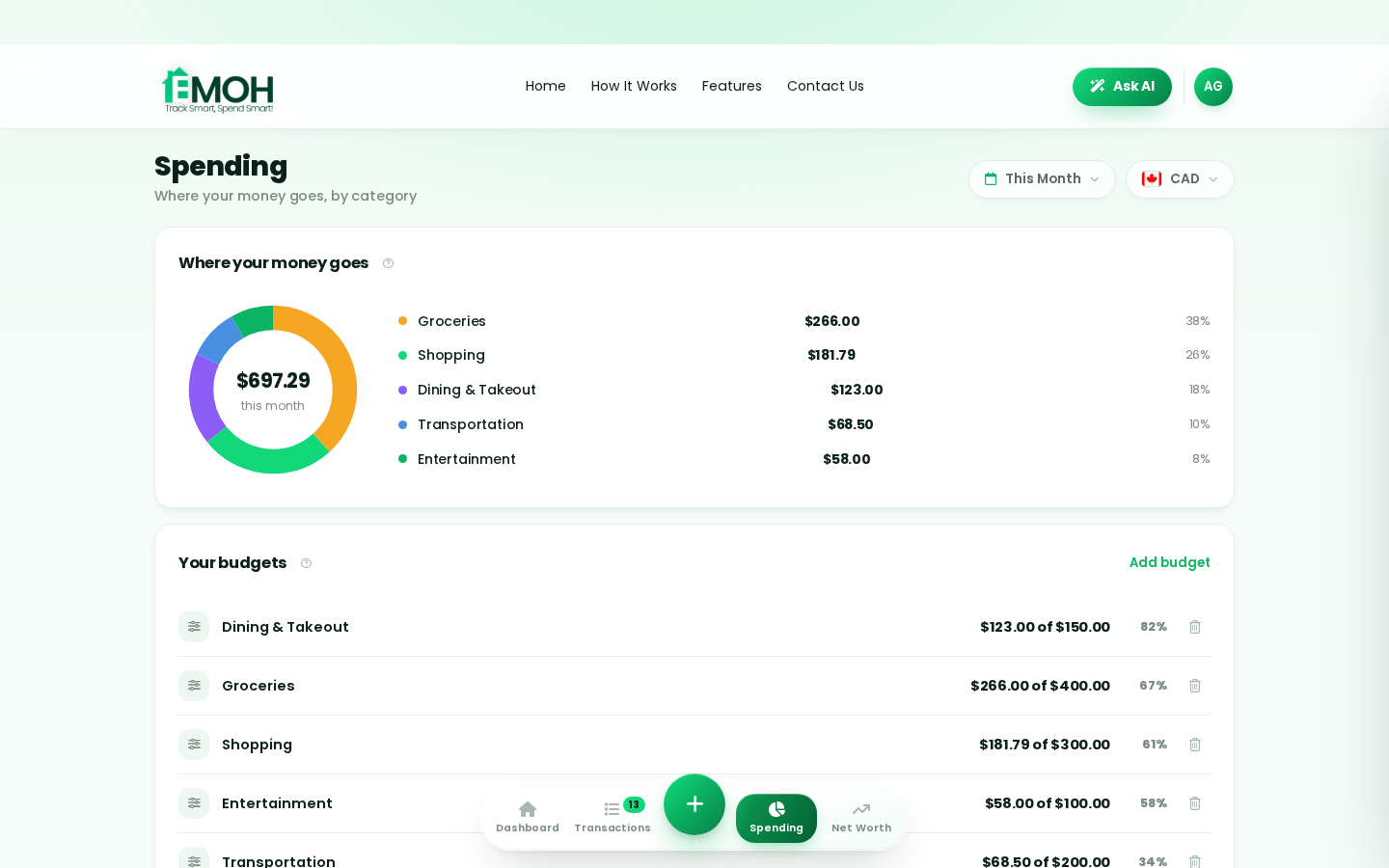
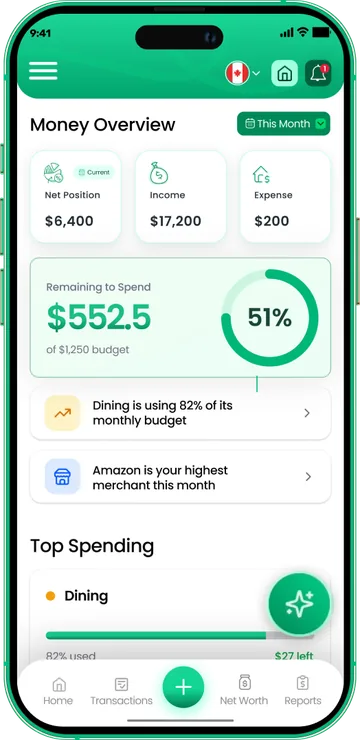
One app for budgeting for couples — on every screen.
Track on your phone in the checkout line, review on the web app at your desk. EMOH Pay keeps budgeting for couples in sync the second anything changes, so the numbers you act on are always current.
Start free on the web➜ Explore all features➜Real spending, really tracked
From the morning coffee to the monthly rent — Canadians log, tag and learn from every expense on EMOH Pay.


Everything you need for budgeting for couples
Track Smart, Spend Smart! The complete toolkit, free to start:
Assets minus debts, always current — watch the number that actually measures progress.
Automatic conversion for money that lives in more than one country.
Log any expense in two taps — or let bank sync do it automatically. Every dollar gets a category.
Vacations, emergencies, down payments — set the target and watch it fill.
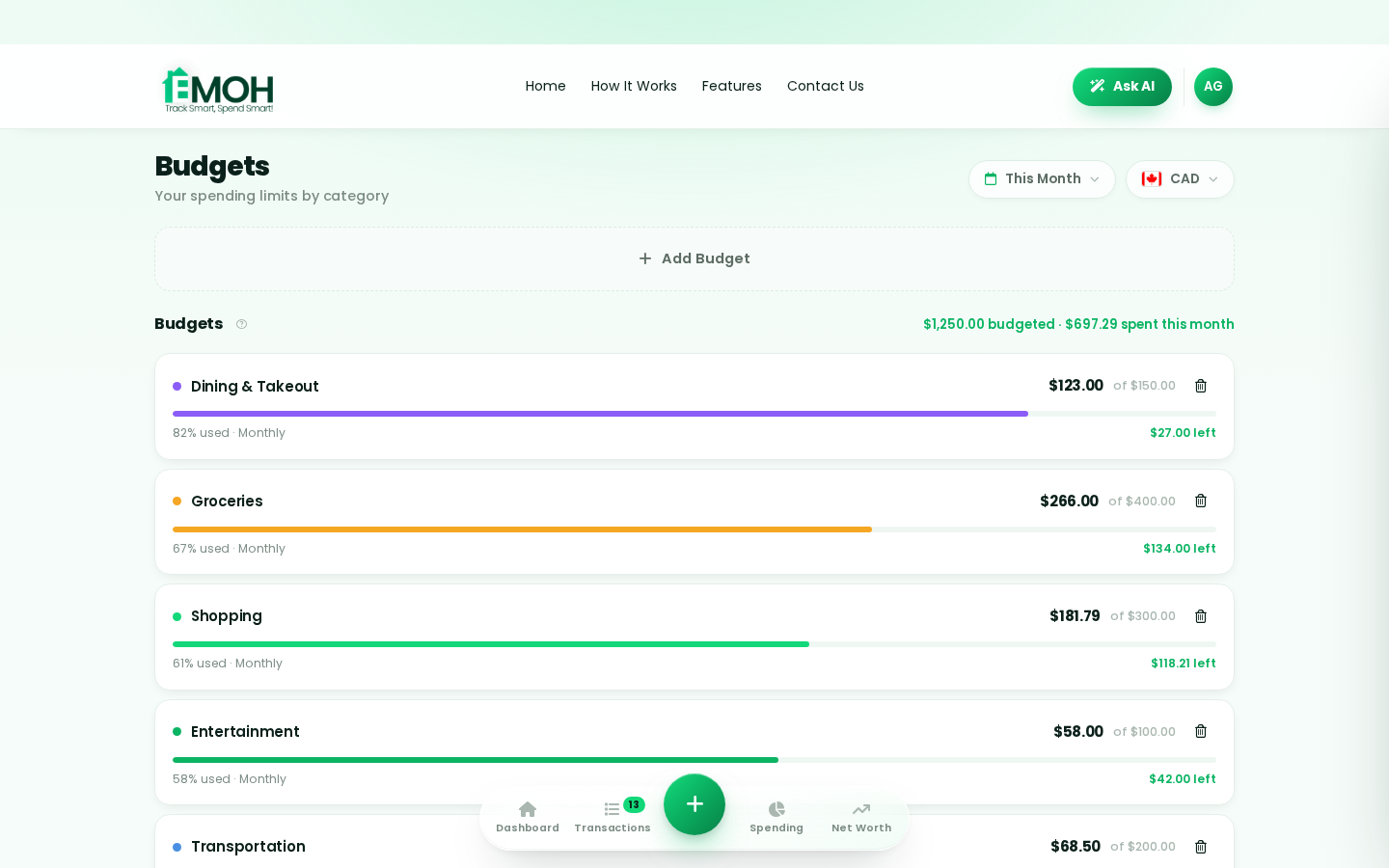
Digital envelopes for groceries, rent and fun, with gentle alerts before you overspend.
Ask questions about your own spending in plain language and get instant answers.
How to start budgeting for couples with EMOH Pay
Four small steps, five minutes total:
EMOH Pay vs. the usual ways to handle budgeting for couples
| EMOH Pay | Spreadsheet | Typical budgeting app | |
|---|---|---|---|
| Free tier | Free forever | Free | Limited trial |
| Paid tier | EMOH Pro — $4.99/mo | — | $10–15/mo |
| Expense tracking | ✔ Two taps or automatic | Manual entry | ✔ |
| Budgets & overspend alerts | ✔ Built in | ✖ None | Varies |
| Net worth tracking | ✔ Live | Formula gymnastics | Often paid add-on |
| Phone + web sync | ✔ Instant | ✖ Manual | Varies |
| Family sharing | ✔ Free | ✖ Shared-file chaos | Often paid add-on |
| GST/HST tracking | ✔ Automatic | ✖ Formula gymnastics | ✖ Rare |
| 148 currencies | ✔ Automatic conversion | ✖ None | Limited |
| Ask AI | ✔ Included | ✖ None | ✖ Rare |
| Daily Money Digest | ✔ Built in | ✖ None | Push spam |
| PDF & Excel exports | ✔ One tap | ✔ Manual | Varies |
| Bank sync (Canada) | ✔ Plaid, read-only (Pro) | ✖ None | US-first, patchy |
Everything above is free to start — and the full EMOH Pro upgrade is just $4.99/month, a third of what typical budgeting apps charge.
Real budgeting for couples problems we actually solve

Budgeting for couples that fits real life
Money habits only stick when they fit the life you already live. EMOH Pay was built for the checkout line, the kitchen-table conversation and the Sunday five-minute review — not for accountants. Two taps to log an expense, one glance to know where you stand.
Get started free➜ See how it works➜Your money data, protected like a bank's
The same encryption standard banks use, protecting your data at rest and in transit.
Bank connections run through Plaid and can only read transactions — never move money.
Built in Canada to Canadian privacy law. Your data is yours — never sold, ever.
Budgeting for couples — frequently asked questions
How is EMOH Pay different from a spreadsheet?
Spreadsheets are flexible but manual: no reminders, no sync, no automatic categorization. EMOH Pay gives you the same control with live sync across devices, daily digests, gentle overspend alerts and one-tap reports.
Does EMOH Pay work on both phone and computer?
Yes. EMOH Pay has full apps for iPhone and Android plus a complete web app, and everything syncs instantly. Phone in your pocket, web app at your desk — the same live numbers everywhere.
Do I need to connect my bank account?
No. Manual tracking is free forever and takes two taps per expense. If you want automatic imports, EMOH Pro connects Canadian banks securely through Plaid with read-only access.
Is EMOH Pay free for budgeting for couples?
Yes — EMOH Pay is free to start on iPhone, Android and the web. Budgeting, expense tracking and net worth are all included, which covers everything you need for budgeting for couples. EMOH Pro adds bank sync via Plaid and advanced AI for just $4.99/month.
What is the best way to get started with budgeting for couples?
Start simple: create a free EMOH Pay account, enter your income and accounts, then set budgets for your top three spending categories. Most people are fully set up in about five minutes, and the Daily Money Digest keeps the habit going.
Is my financial data safe with EMOH Pay?
Yes. EMOH Pay uses AES-256 encryption, bank connections are read-only through Plaid, and the app is built to Canadian PIPEDA privacy standards. Your data is never sold.
More from EMOH Pay
Start free today
Free on iPhone, Android and the web. Upgrade to EMOH Pro anytime for bank sync and advanced AI.
Download for iOS➜ Get it on Android➜