
Average Net Worth by Age
Net worth usually climbs through your working years and peaks just before retirement. Here is what Statistics Canada's data shows by age, and how to read it without discouragement.
Get started free➜ Download the app➜
What is the average net worth by age?
Average net worth by age in Canada rises from under $50,000 for families led by someone under 35 to a peak of about $690,000 for ages 55 to 64, based on Statistics Canada's 2019 Survey of Financial Security medians. It eases slightly in retirement. Averages run far higher because a few very wealthy households pull them up.
Average net worth by age in Canada
The average net worth by age follows a clear pattern: low in early adulthood, rising steeply through the 30s, 40s and 50s, and peaking in the years before retirement. The most reliable Canadian figures come from Statistics Canada's Survey of Financial Security, which measures the assets and debts of families every few years.
The figures below are medians from the 2019 survey, grouped by the age of the family's major income earner. A median is the middle family: half have more, half have less. Statistics Canada has published newer survey results and quarterly wealth estimates since then, and household net worth has generally risen with home prices and investments. Treat these as a baseline and check the latest tables on the Statistics Canada site.
Figures checked September 2026; confirm current numbers with Statistics Canada.
Median net worth versus average net worth
Median net worth is a better guide than average net worth because a small number of very wealthy households pull the average far above what a typical family has. If you compare yourself with the average, you are comparing with a number most people never reach. The median shows the middle of the pack.
- Canada. Statistics Canada reports both, and the average for every age group is well above the median.
- United States. The Federal Reserve's 2022 Survey of Consumer Finances put median family net worth at about $192,900 US, while the mean was about $1,063,700 US. That gap shows how much a few large fortunes distort an average.
- For your own planning, compare with the median for your age group, then focus on your own trend over time.
Net worth by age in Canada: what drives the differences?
Net worth by age in Canada is shaped mainly by home ownership, time in the workforce and pension savings. Younger families often rent, carry student debt and have had little time to save. By the 50s, many have paid down a mortgage, built RRSP and pension balances and benefited from years of compound growth.
| Age group | Typical situation | Main drivers |
|---|---|---|
| Under 35 | Renting or new mortgage, student loans, early career | Paying off debt, starting a TFSA, first down payment |
| 35 to 44 | Mortgage, young children, rising income | Home equity, RRSP and workplace pension growth |
| 45 to 54 | Peak earning years, mortgage shrinking | Accelerated savings, investments compounding |
| 55 to 64 | Mortgage often paid off, retirement close | Largest home equity and pension balances |
| 65 and over | Retired, drawing on savings | Withdrawals from RRIFs and savings; home equity remains |

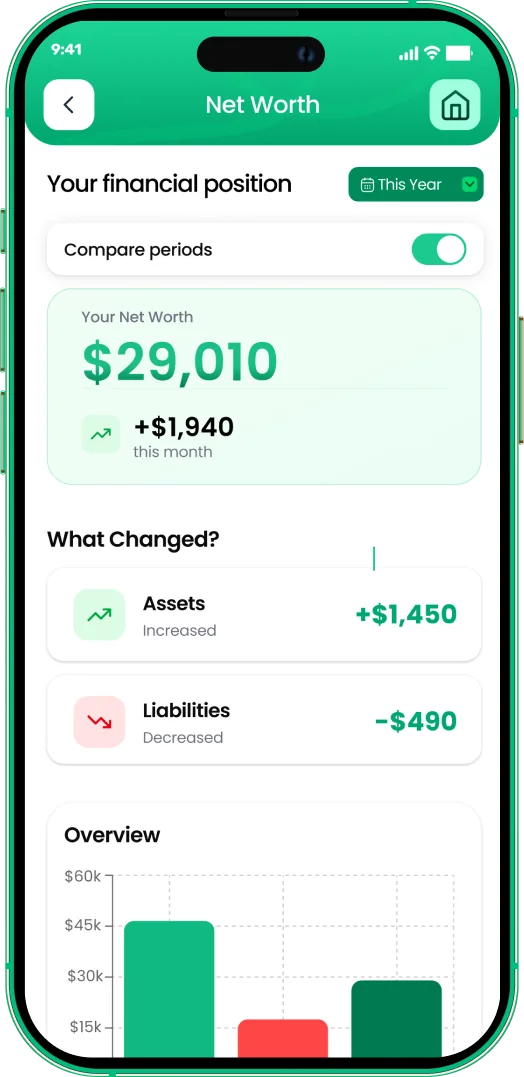
Watch your net worth grow
- Add assets and debts in any of 148 currencies
- See what changed month by month
- Set savings goals and track progress


Why your number may look very different
- Where you live. Families in high-priced housing markets can show large net worth on paper because of home equity, even with modest cash savings.
- Renting versus owning. Renters often have lower net worth in surveys, though disciplined investing can close the gap.
- Pensions. Some surveys count the value of employer pension plans, which can add a large amount for public sector workers.
- Debt. Student loans, car loans and credit cards subtract directly. Our summary of household debt in Canada shows how common these are.
- Income. Higher-income families save more in dollars. See average household income in Canada for context.
How to calculate and track your own net worth
To calculate your own net worth, add up everything you own and subtract everything you owe. Assets include bank balances, TFSA, RRSP and FHSA accounts, investments, pension value and the market value of your home and car. Debts include your mortgage, loans, lines of credit and card balances.
- List every asset with its current value.
- List every debt with its current balance.
- Subtract total debts from total assets.
- Record the result and the date.
- Repeat every month or quarter and watch the trend, not the single number.
The free net worth calculator does the adding for you, and how to calculate net worth explains what to include. EMOH Pay's net worth tracker keeps a running total across your accounts in 148 currencies, so you can see progress month by month.
How to grow your net worth at any age
Growing your net worth comes down to two levers: spending less than you earn and putting the difference to work. Paying off high-interest debt raises net worth as surely as saving, because every dollar of debt removed is a dollar added. Automating contributions to a TFSA or RRSP on payday makes the habit stick.
Starting early matters more than starting big. A family under 35 with a median net worth near $49,000 in 2019 had decades for compound growth ahead. Small, steady contributions and a shrinking debt balance are what move the number over time.
Your net worth in EMOH Pay




Put the numbers on autopilot
EMOH Pay tracks your spending, budgets and net worth on your phone and in the browser, always in sync. Free to start, made in Canada.
Get started free➜Average Net Worth by Age: frequently asked questions
What is a good net worth by age 30 in Canada?
There is no single target. Statistics Canada's 2019 median for families led by someone under 35 was about $49,000, so a positive and rising net worth at 30 is a solid position.
Should I use average or median net worth to compare?
Median. The average is pulled up by a small number of very wealthy households and does not reflect a typical family.
Does net worth include my home?
Yes. Your home's market value counts as an asset and your mortgage balance as a debt. The difference is your home equity.
Why does net worth fall after 65?
Many retirees draw on savings, RRIFs and pensions to cover living costs, so assets slowly decline. Home equity often remains a large share.
How often should I calculate my net worth?
Monthly or quarterly is enough. The trend over a year tells you far more than any single reading.
Sources and further reading
Related guides and tools
Net worth is everything you own minus everything you owe. Enter your assets and debts for your number — then track it…
How to Calculate Net WorthNet worth = everything you own minus everything you owe. It's the single best number for tracking long-term financial…
The free net worth tracker that shows your real progress.EMOH Pay's net worth tracker adds up everything you own, subtracts everything you owe, and shows the trend over time — free…
How to Track Net Worth in Canada: A Beginner’s GuideUnderstanding your financial health is the first step toward building a secure future. One of the most effective ways to get…
Canadian Household Debt StatisticsHousehold debt in Canada explained with Statistics Canada and Bank of Canada data: debt-to-income ratio, what Canadians owe…
Average Household Income in CanadaAverage household income in Canada explained: median total and after-tax income from Statistics Canada, how it differs by…
Start free today
Free on iPhone, Android and the web. Upgrade to EMOH Pro anytime for bank sync and advanced AI.
Download for iOS➜ Get it on Android➜