
How to set financial goals effectively

Establishing financial goals is an essential step towards success in finances. Having objective and actionable targets can significantly impact your financial success, whether your goal is to purchase a house, prepare for retirement, or simply optimize your household budget . In this blog, we will discuss how to set financial goals properly, the contrast between long-term financial goals and short-term financial goals , and how to utilize SMART financial goals to remain on course. We will also reveal proven financial tips , easy budgeting tips , and money management tips that will assist you in meeting your personal finance goals.
Why Setting Financial Goals Matters
Without financial goals , it’s simple to become unfocused on your spending, savings, and investments. Goals provide direction, motivation, and a method to track your progress. Whether you’re concerned with effective financial planning or merely want to make your household budget better, having an agenda is crucial.
Here’s why financial goal -setting is vital:
- Clarity and Focus: Goals allow you to focus on what matters and cut out wasteful expenses.
- Motivation: The process of achieving smaller goals keeps you going to tackle larger ones.
- Accountability: Goals instill a sense of duty, helping you adhere to your budgeting.
- Long-Term Security: Having long-term financial goals ensures that you are set for the future, be it retirement, owning a home, or financing your kid’s education.
Types of Financial Goals
In the context of financial goal strategies, you need to know the varying kinds of goals you can achieve. These generally occur in two forms: short-term financial goals and long-term financial goals.
1. Short-Term Financial Goals
These are objectives you have in mind that you want to accomplish in one year or sooner. Some examples are:
- Saving an emergency fund.
- Eliminating a small debt.
- Saving up for a holiday or a new gadget.
- Bettering your household budget by reducing unnecessary spending.
Short-term objectives are usually stepping stones to more significant goals. They assist you in gaining momentum and confidence with your money-saving advice.
2. Long-Term Financial Goals
These objectives take longer to realize, typically extending over a few years or even decades. Some examples are:
- Saving for retirement.
- Purchasing a home.
- Educating your child.
- Accumulating wealth through investments.
Long-term financial objectives need sustained effort and good money planning. They usually entail more money and complicated tactics.
How to Set SMART Financial Goals
One of the best-tested personal finance tips on goal setting is using the SMART principle. SMART means Specific, Measurable, Achievable, Relevant, and Time-bound. This is how to apply it to your financial goals :
- Specific: Be precise about what you wish to attain. For instance, rather than saying, “I want to save money,” you can say, “I want to save $5,000 for a car down payment.
- Measurable: Ensure your goal can be tracked. For instance, “I will save $200 every month.”
- Achievable: Set realistic goals based on your income and expenses. If you’re struggling with your household budget , start small and gradually increase your savings.
- Relevant: Align your goals with your broader financial priorities. For example, if you’re focused on long-term financial goals, prioritize saving for retirement over short-term luxuries.
- Time-bound: Set a deadline for achieving your goal. For example, “I will save $5,000 in 12 months.”
By setting SMART financial goals , you’ll have a clear roadmap to follow and a higher chance of success.
Proven Financial Tips for Achieving Your Goals
Here are some tried and tested financial tips to assist you in setting and attaining your financial objectives:
1. Develop a Household Budget
A budget for your household is the key to successful financial planning . It assists you in monitoring your expenses and income, finding areas where you can save, and investing in your financial goals. Apply simple budgeting strategies such as the 50/30/20 rule:
- 50% for necessities (rent, bills, food).
- 30% for discretionary spending (dining out, entertainment).
- 20% for saving and paying off debt.
2. Prioritize Your Goals
Not all objectives are equal. Rank your short-term money objectives and long-term money objectives in importance and urgency. For instance, paying down high-interest debt is more important than saving for a vacation
3. Automate Your Savings
Automation is one of the great money management tips for staying on track. Set up automatic transfers to your savings accounts to make sure that you are working towards your financial goals
4. Track Your Progress
Regularly review your financial planning to make sure that you are on the right path. Use a few apps or even spreadsheets to look for your spending, savings, and investments.
5. Adjust as Needed
Life is full of surprises, and your financial objectives might have to be adjusted from time to time. Be adaptable and open to revising your plans as your situation changes.
Best Financial Goals to Consider
Here are a few examples of the best financial objectives you can have:
- Create an Emergency Fund: Save 3-6 months’ worth of living costs.
- Retire High-Interest Debt: Pay off high-interest debt like credit cards or personal loans.
- Save for Retirement: Make contributions to a RRSP or IRA for securing your future.
- Invest in Yourself: Invest in courses or certifications that will raise your earning power.
- Buy a Home: Save up for a down payment and build your credit score.
- Start a Side Hustle: Make extra money to speed up your savings.
Financial Success Strategies
Becoming financially successful takes more than goal setting. Here are some financial success strategies to help you become successful to remember:
- Stay Disciplined: Adhere to your home budget and avoid making impulse purchases.
- Educate Yourself: Keep learning about money management advice, investing tips, and financial planning.
- Seek Professional Advice: Engage with a financial adviser to get a customized plan.
- Celebrate Milestones : Treat yourself once you attain a goal so you can remain motivated.
Conclusion
Creating financial goals is the initial step to financial success. Whether your short-term financial objectives are to save for an emergency fund or your long-term goals are to save for retirement, the key is to be intentional and disciplined. Utilize the SMART financial goal framework, abide by successful financial advice, and apply simple budgeting advice to remain on course.
Remember, effective financial planning is a journey, not a destination. By setting clear personal finance goals and following these financial goal strategies, you’ll be well on your way to a secure and prosperous future.
Try the free budget calculator
Reading is step one — EMOH Pay makes it automatic. Free to start on phone and web.
Open it➜What should you know about setting financial goals effectively?
Setting financial goals effectively comes down to three habits: know what comes in, decide where it goes, and check in daily. EMOH Pay makes all three effortless — free expense tracking and budgets on phone and web, a Daily Money Digest each morning, and bank-grade AES-256 security throughout.
Setting financial goals effectively: the essentials
You can start setting financial goals effectively today at $0 — no card required, on iPhone, Android or the web.
Five minutes a week with a daily digest beats a perfect spreadsheet you abandon in February.
The first win in setting financial goals effectively is simply seeing where money goes. Tracking alone typically surfaces 10–15% of easy savings.
Auto-categorization, recurring bills and bank sync take the admin out of the habit.
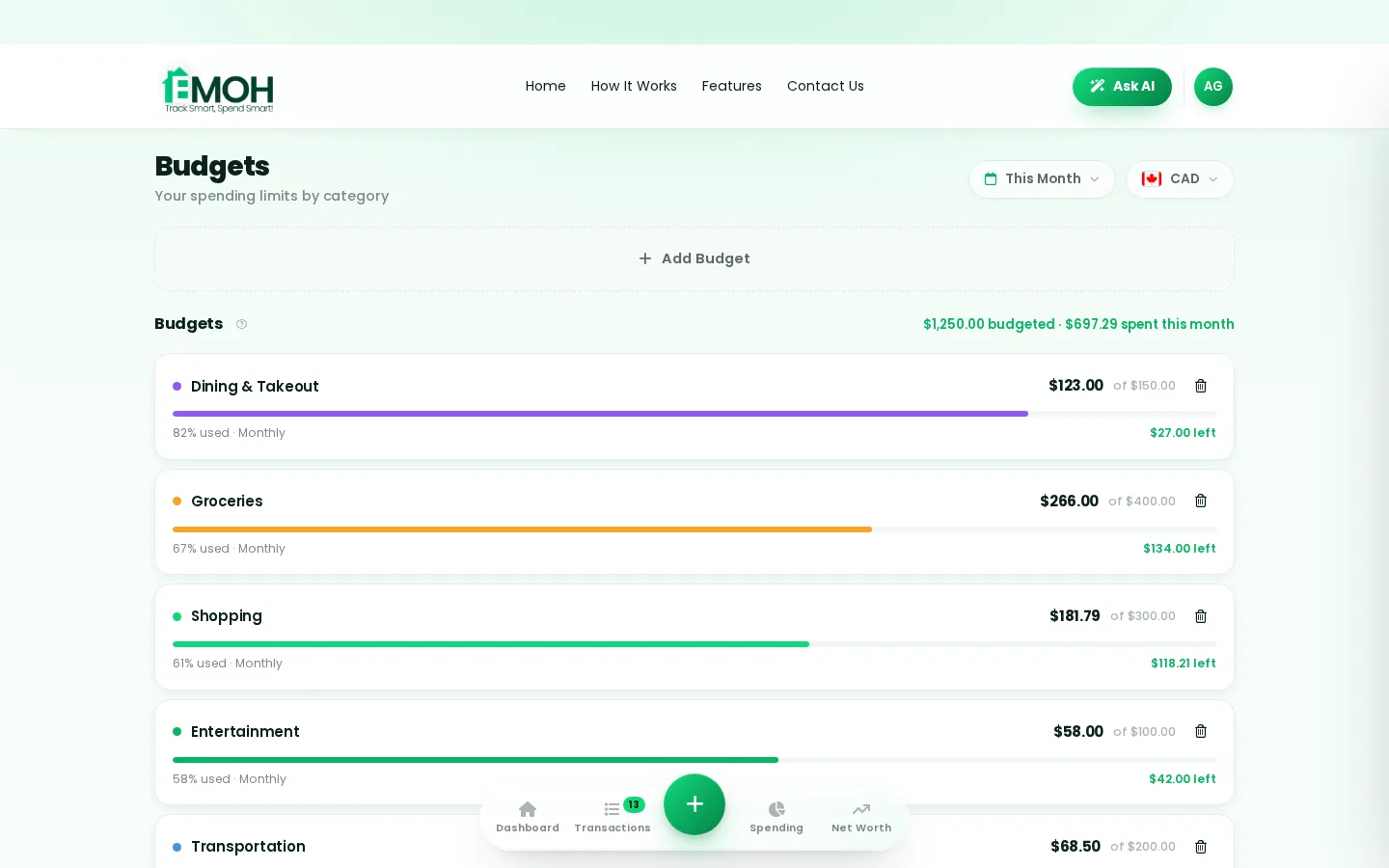
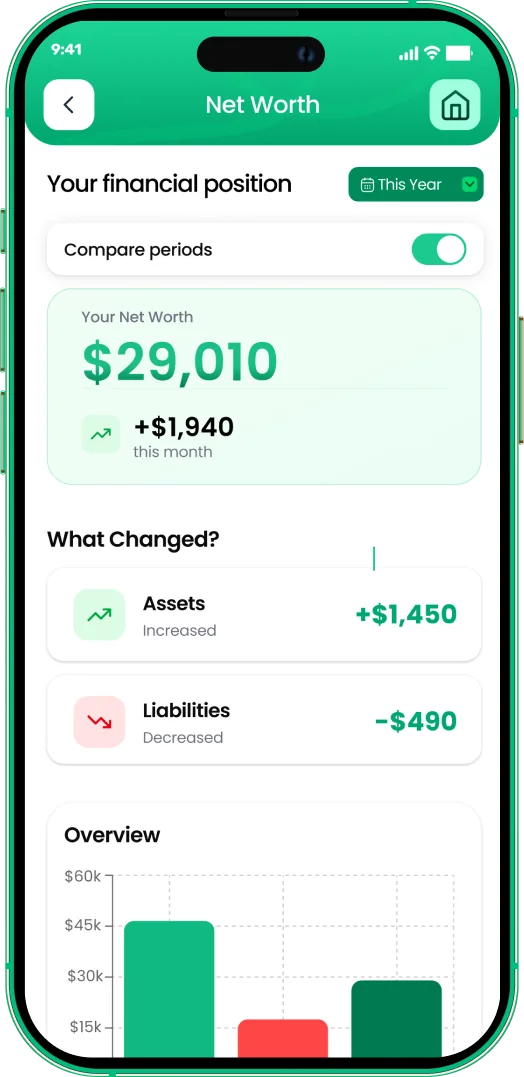
One app for setting financial goals effectively — on every screen.
Track on your phone in the checkout line, review on the web app at your desk. EMOH Pay keeps setting financial goals effectively in sync the second anything changes, so the numbers you act on are always current.
Start free on the web➜ Explore all features➜Real spending, really tracked
From the morning coffee to the monthly rent — Canadians log, tag and learn from every expense on EMOH Pay.



Everything you need for setting financial goals effectively
Track Smart, Spend Smart! The complete toolkit, free to start:
Ask questions about your own spending in plain language and get instant answers.
Everyone sees the same live numbers, each with their own login. Free forever.
Log any expense in two taps — or let bank sync do it automatically. Every dollar gets a category.
Digital envelopes for groceries, rent and fun, with gentle alerts before you overspend.
Assets minus debts, always current — watch the number that actually measures progress.
Turn any month into a clean report you can share with a partner or accountant.
How to start setting financial goals effectively with EMOH Pay
Four small steps, five minutes total:
- 1Make your account — free, on phone or web
- 2Enter your income & accounts
- 3Set budgets — your digital envelopes
- 4Track smart, spend smart — EMOH digests daily
EMOH Pay vs. the usual ways to handle setting financial goals effectively
| EMOH Pay | Spreadsheet | Typical budgeting app | |
|---|---|---|---|
| Free tier | Free forever | Free | Limited trial |
| Paid tier | EMOH Pro — $4.99/mo | — | $10–15/mo |
| Expense tracking | ✔ Two taps or automatic | Manual entry | ✔ |
| Budgets & overspend alerts | ✔ Built in | ✖ None | Varies |
| Net worth tracking | ✔ Live | Formula gymnastics | Often paid add-on |
| Phone + web sync | ✔ Instant | ✖ Manual | Varies |
| Family sharing | ✔ Free | ✖ Shared-file chaos | Often paid add-on |
| GST/HST tracking | ✔ Automatic | ✖ Formula gymnastics | ✖ Rare |
| 148 currencies | ✔ Automatic conversion | ✖ None | Limited |
| Ask AI | ✔ Included | ✖ None | ✖ Rare |
| Daily Money Digest | ✔ Built in | ✖ None | Push spam |
| PDF & Excel exports | ✔ One tap | ✔ Manual | Varies |
| Bank sync (Canada) | ✔ Plaid, read-only — free up to 3 banks | ✖ None | US-first, patchy |
Everything above is free to start — and the full EMOH Pro upgrade is just $4.99/month, a third of what typical budgeting apps charge.
Real setting financial goals effectively problems we actually solve

Setting financial goals effectively that fits real life
Money habits only stick when they fit the life you already live. EMOH Pay was built for the checkout line, the kitchen-table conversation and the Sunday five-minute review — not for accountants. Two taps to log an expense, one glance to know where you stand.
Get started free➜ See how it works➜Your money data, protected like a bank's
The same encryption standard banks use, protecting your data at rest and in transit.
Bank connections run through Plaid and can only read transactions — never move money.
Built in Canada to Canadian privacy law. Your data is yours — never sold, ever.
Setting financial goals effectively — frequently asked questions
Is EMOH Pay free for setting financial goals effectively?
Yes — EMOH Pay is free to start on iPhone, Android and the web. Budgeting, expense tracking and net worth are all included, which covers everything you need for setting financial goals effectively. EMOH Pro lifts the limits for just $4.99/month — unlimited bank connections, family members and EMOH Smart, plus full report history and exports.
Do I need to connect my bank account?
No. Manual tracking is free forever and takes two taps per expense. If you want automatic imports, connect a Canadian bank securely through Plaid with read-only access — three banks on Free, unlimited on Pro.
Does EMOH Pay work on both phone and computer?
Yes. EMOH Pay has full apps for iPhone and Android plus a complete web app, and everything syncs instantly. Phone in your pocket, web app at your desk — the same live numbers everywhere.
What is the best way to get started with setting financial goals effectively?
Start simple: create a free EMOH Pay account, enter your income and accounts, then set budgets for your top three spending categories. Most people are fully set up in about five minutes, and the Daily Money Digest keeps the habit going.
Is my financial data safe with EMOH Pay?
Yes. EMOH Pay uses AES-256 encryption, bank connections are read-only through Plaid, and the app is built to Canadian PIPEDA privacy standards. Your data is never sold.
Can I share my budget with my family?
Yes — Family Account Sharing is included free. Each member gets their own login while budgets and expenses stay shared in real time, which makes setting financial goals effectively a team effort instead of a solo chore.
More from EMOH Pay
Having financial goals is the first step in ensuring long-term financial success . These could include strategies to…
How to Build a Strong Financial Foundation for Your FamilyDeveloping a strong financial foundation for your family is one of the most essential steps you can take to ensure long-term…
Top Financial Habits That Can Make or Break Your BudgetThe ability to effectively manage your money is defined by the habits you have regarding your finances. Your ability to…
Free Budget CalculatorThe 50/30/20 rule splits after-tax income: 50% to needs, 30% to wants, 20% to savings. Enter your monthly take-home pay to…
EMOH Pay vs YNABEMOH Pay vs YNAB compared honestly for 2026: price, Canadian features, family sharing, bank sync and learning curve — free…
Free Budgeting App CanadaEMOH Pay is a budgeting app made in Canada — free to start on iPhone, Android and the web. Set monthly budgets, track…
Start free today
Free on iPhone, Android and the web. Upgrade to EMOH Pro anytime for bank sync and advanced AI.
Download for iOS➜ Get it on Android➜